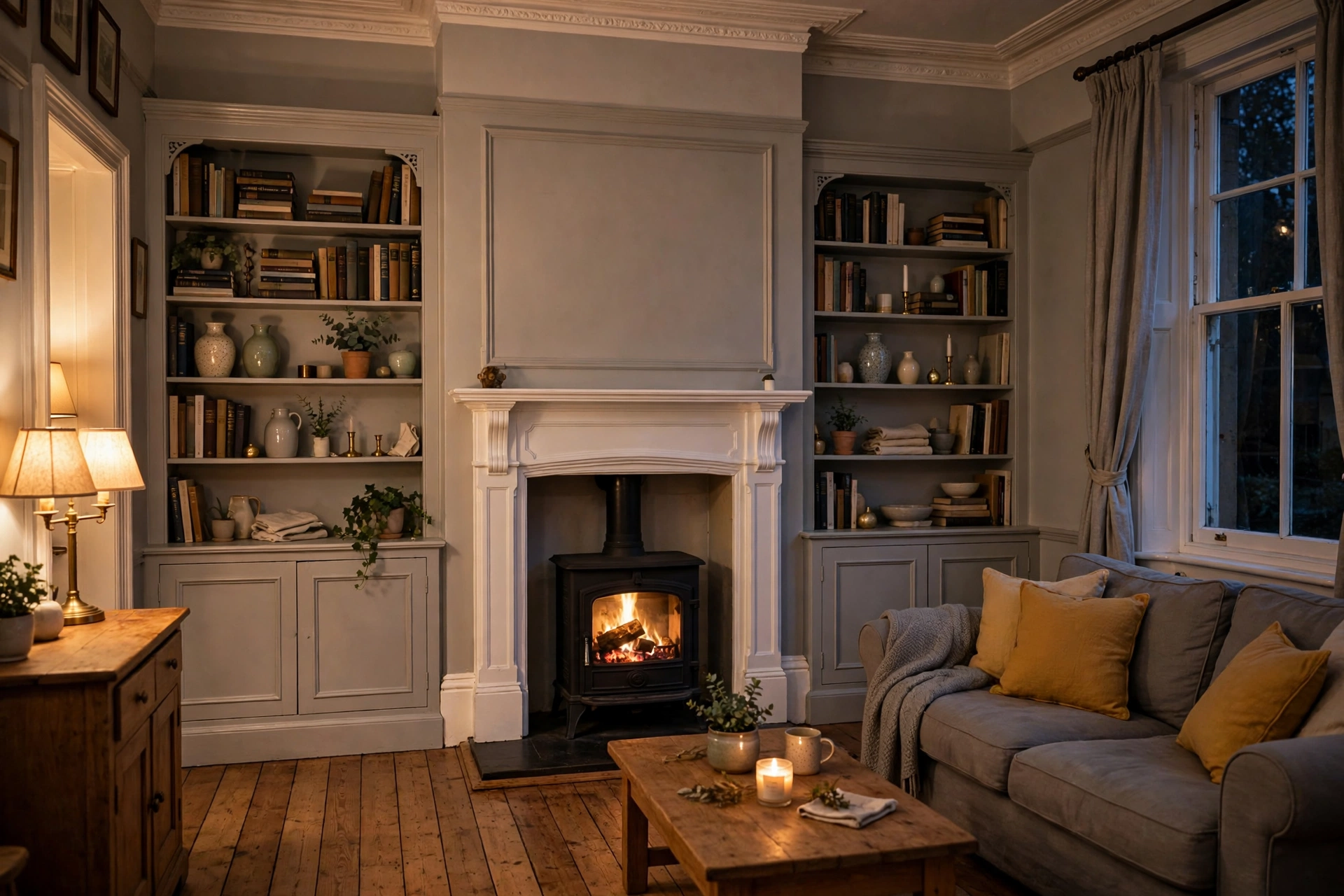
Short answer: The best alcove ideas for a UK living room turn those awkward recesses beside the chimney breast into useful, beautiful features. Built-in shelving is the classic choice, but alcoves also work brilliantly as reading nooks, TV housing, home-office corners, log stores or mini bars. The trick is to treat each alcove as a deliberate design moment, not leftover space.
What Is an Alcove in a Living Room?
An alcove is the recessed space on either side of a chimney breast, the part of the wall that juts out into the room to house the fireplace and flue. Most UK homes built before 1930 have a chimney breast, which means two ready-made alcoves in almost every period living room. They are usually 60 to 100 cm wide and 30 to 45 cm deep, generous enough for shelves, a small desk or an armchair, but awkward enough that many people simply ignore them. That is a waste, because an alcove is one of the easiest places in a living room to add storage and character without moving a single wall.
Why Alcoves Feel So Awkward
Alcoves feel awkward for three simple reasons. First, they are too narrow for standard furniture but too deep to leave empty. Second, they sit in the shadow of the fireplace, so they often look darker than the rest of the room. Third, because they are recessed, anything placed in them looks as though it has been pushed aside rather than chosen. The fix for all three problems is the same: give the alcove a clear job, and it stops looking like leftover space.
17 Alcove Ideas for Your Living Room
1. Classic Built-In Shelving
Built-in shelves running from floor to ceiling make the alcove look like part of the architecture. Paint them the same colour as the wall for a seamless look, or a shade darker for definition. A shelf depth of 25 to 30 cm suits books, while 20 cm suits ornaments.
2. Floating Shelves for a Lighter Look
Two or three chunky oak floating shelves give you display space without dominating the room, and they cost a fraction of fitted joinery. Fix them into solid brick or use proper plasterboard fixings, because a shelf full of hardbacks is heavier than it looks.
3. A Cosy Reading Nook
A deep alcove can hold a snug armchair, a small side table and a reading lamp, instantly creating a nook that feels tucked away from the rest of the room. Add a cushion, a folded throw and a small shelf at arm height for the book you are reading. For more inspiration on layering softness into a small space, see our small snug ideas.
4. Cupboards Below, Shelves Above
The most useful alcove combination in a family living room is closed storage at the bottom and open shelving at the top. Low cupboards hide board games, chargers and clutter, while the shelves above show off the things you actually want to see. Shaker-style doors painted in Farrow & Ball or Dulux colours suit both period and modern rooms.
5. House the Television
An alcove is often the perfect width for a television, and putting the screen inside the recess keeps it from dominating the room. Mount the TV on a pull-out bracket so you can angle it towards the sofa, with a low cupboard below to hide cables and consoles. If your alcove is beside a working fireplace, keep a sensible gap from the wood burner to avoid heat damage.
6. A Log Store Beside the Fire
If you have a working fireplace or log burner, the alcove beside it is the natural home for your firewood. A neat stack of logs is both practical and decorative, adding warmth and texture to the room. Keep the stack a little way back from the fire opening and never block ventilation.
7. A Home-Office Nook
Working from home without a spare room? An alcove can become a compact home office with a wall-mounted desk, a comfortable chair and a shelf above for files. The recess naturally frames the workspace, which helps you switch off at the end of the day by closing a cupboard door or drawing a curtain across the opening.
8. A Mini Bar or Drinks Cabinet
For evening entertaining, turn an alcove into a mini bar with a mirrored back panel, a couple of glass shelves and a small cabinet below. Keep bottles, glasses and a cocktail shaker on display, and add a picture light or LED strip so the alcove glows in the evening. The Range and Homesense are good hunting grounds for affordable barware and brass accessories.
9. Display Shelves for Collections
Alcoves are made for collections. Whether it is ceramics, vinyl records, travel souvenirs or framed family photographs, a dedicated display alcove gives your collection a home instead of scattering it across every surface. The trick is restraint: group objects in odd numbers, vary the heights, and leave empty space between groups so each piece can breathe.
10. Colour-Drench the Alcove
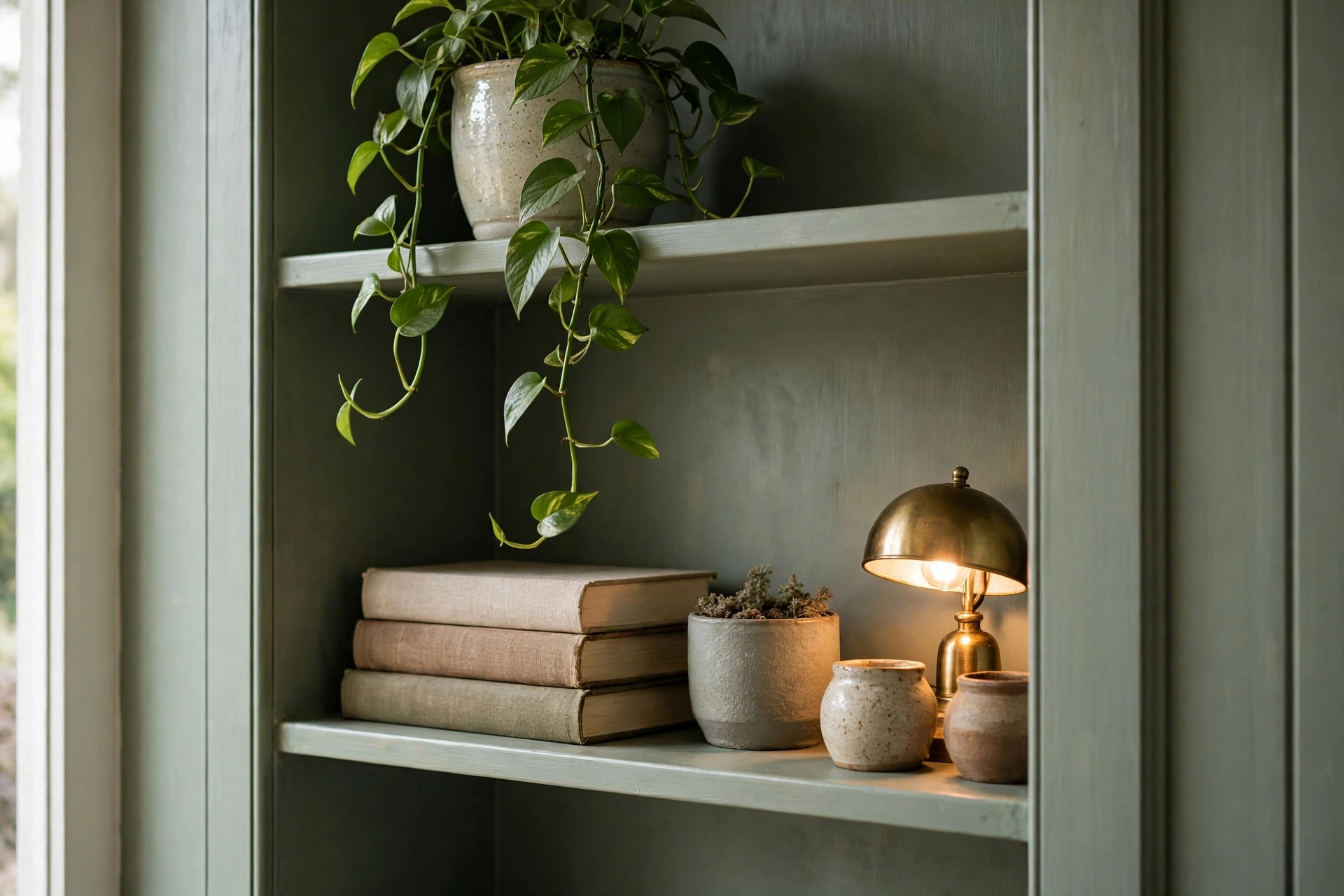
Painting the inside of an alcove a bold colour is one of the cheapest ways to make it a feature. A deep green, inky blue or warm terracotta inside the recess creates depth and makes the objects on the shelves stand out. Try Farrow & Ball Green Smoke or Dulux Sapphire Salute, and paint the shelves the same shade for a seamless, fitted look.
11. Wallpaper the Back Panel
If paint feels too permanent, wallpaper just the back wall of the alcove. A bold pattern inside a small recess reads as a deliberate design statement, and you only need one or two rolls, so it is an affordable way to try a pattern you love. In a rented home, use removable peel-and-stick wallpaper so the whole look can come down when you move out.
12. Add Dedicated Alcove Lighting
Alcoves are often the darkest part of a living room, so lighting changes everything. Battery-operated LED strips under each shelf, a small picture light above a painting, or a slim floor lamp tucked into the corner all lift the alcove out of shadow. Warm white bulbs, around 2700K, keep the glow cosy rather than clinical.
13. Fill It with Plants
A plant-filled alcove softens the hard lines of a chimney breast and brings life into a corner that can otherwise feel stark. Trailing plants like pothos look wonderful spilling down from a high shelf, while a tall fiddle-leaf fig or olive tree can fill a deep alcove at floor level. Choose plants that tolerate lower light if your alcove sits away from the window.
14. Hidden Toy Storage for Family Living Rooms
In a family home, the alcove closest to the sofa can become the toy cupboard. Low cupboards or baskets inside the alcove keep toys within reach but out of sight when guests arrive, and children quickly learn that everything has a home. This is the same principle behind many of our cosy living room ideas for winter, where the room stays calm because everything has a place.
15. Hang a Statement Mirror
A large mirror inside an alcove bounces light around the room and makes the recess feel wider and brighter. Lean a tall arched mirror against the back wall for a relaxed look, or hang a round mirror above a small console table inside the alcove. For hallway inspiration in the same style, see our Victorian terrace hallway ideas.
16. Mix Open and Closed Storage
The most liveable alcoves combine both. Open shelves show off books and objects, while closed cupboards or drawers hide the practical clutter of everyday life. A good rule of thumb is roughly two-thirds open and one-third closed, or the reverse if your household generates more clutter than display pieces. Woven baskets on open shelves offer a middle ground: they look tidy while keeping contents hidden.
17. Leave One Alcove Almost Empty
Sometimes the best alcove idea is restraint. If both alcoves are crammed with shelves and objects, the fireplace wall can feel busy and overwhelming. Try furnishing one alcove fully and leaving the other almost empty, with just a tall vase, a floor lamp or a single piece of art. The empty space gives the eye somewhere to rest and makes the furnished alcove look even better by contrast.
Built-In vs Freestanding Alcove Storage
Choosing between fitted joinery and freestanding furniture is the biggest decision in any alcove project. Here is how the two options compare:
- Built-in shelving: made to measure, uses every centimetre and adds value to period homes, but costs more and is permanent.
- Freestanding furniture: affordable, removable and renter-friendly, but you will usually be left with small gaps at the sides.
- Flat-pack hacks: the middle ground. IKEA Billy bookcases or Besta cabinets can be joined together and painted to look built-in, for a fraction of the cost of bespoke joinery.
- Best for renters: floating shelves, leaning bookcases and freestanding cabinets, plus peel-and-stick wallpaper and battery lighting that leave no trace.
- Best for homeowners: fitted cupboards and shelving, colour-drenched paint and wired lighting, all of which add lasting value.
How to Style Alcove Shelves Like a Professional
Work in groups of three or five, mixing tall, medium and small objects so the eye moves across the shelf. Repeat one colour or material across the shelves to tie the display together. Stack some books horizontally as well as vertically, and use the horizontal stacks as plinths for smaller objects. Leave roughly a third of each shelf empty: negative space is what separates a styled shelf from a storage shelf. Finally, step back and look at the whole fireplace wall, because the alcoves and the chimney breast should feel balanced as a pair.
Common Alcove Mistakes to Avoid
The most common mistake is filling every shelf to the brim, which makes the alcove look like a cupboard rather than a feature. Another is mismatched depths: shelves that are too deep stick out awkwardly, while shelves that are too shallow leave a dusty gap behind them, so measure twice and build to the exact depth of the recess. A third mistake is forgetting the lighting, which leaves the alcove looking like a dark hole beside a bright fireplace. And finally, avoid putting a television in one alcove and a bookshelf in the other without any visual link between them; repeat a colour or a style on both sides so the wall reads as one composition.
Frequently Asked Questions
What should I put in a living room alcove?
Start with the job the alcove needs to do. Built-in shelving suits books and display pieces, cupboards suit clutter and media equipment, and a chair with a lamp turns an alcove into a reading nook. In most UK living rooms, the winning combination is cupboards below and open shelves above.
How deep should alcove shelves be?
A shelf depth of 25 to 30 cm suits most books, while 20 cm is enough for ornaments, framed prints and small plants. Measure your alcove before buying or building anything, because recesses in period homes are rarely perfectly square.
Can I put a TV in a living room alcove?
Yes, an alcove is often the ideal spot for a television, especially in period homes where the recess is roughly the width of a modern screen. Mount the TV on a pull-out bracket so you can angle it towards the sofa, and hide the cables inside the wall or a cable channel.
How much does built-in alcove shelving cost in the UK?
Costs vary by region and materials, but as a rough guide, a pair of simple painted MDF alcove units with shelves and cupboards typically costs a few hundred pounds in materials plus a joiner’s day rate. Flat-pack hacks using IKEA Billy or Besta units are the budget route, often coming in well under the cost of bespoke joinery while still looking smart once painted and trimmed to fit.