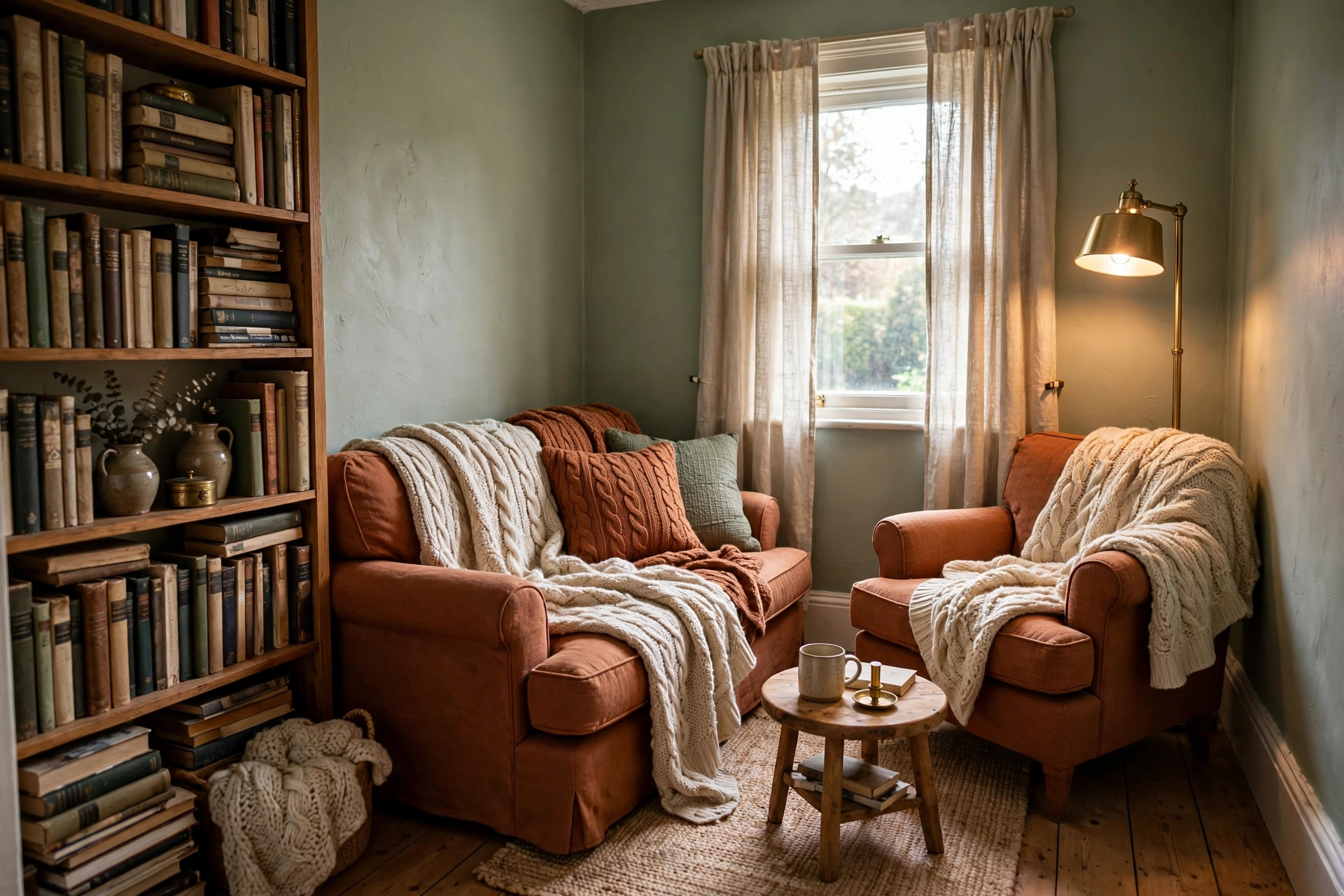
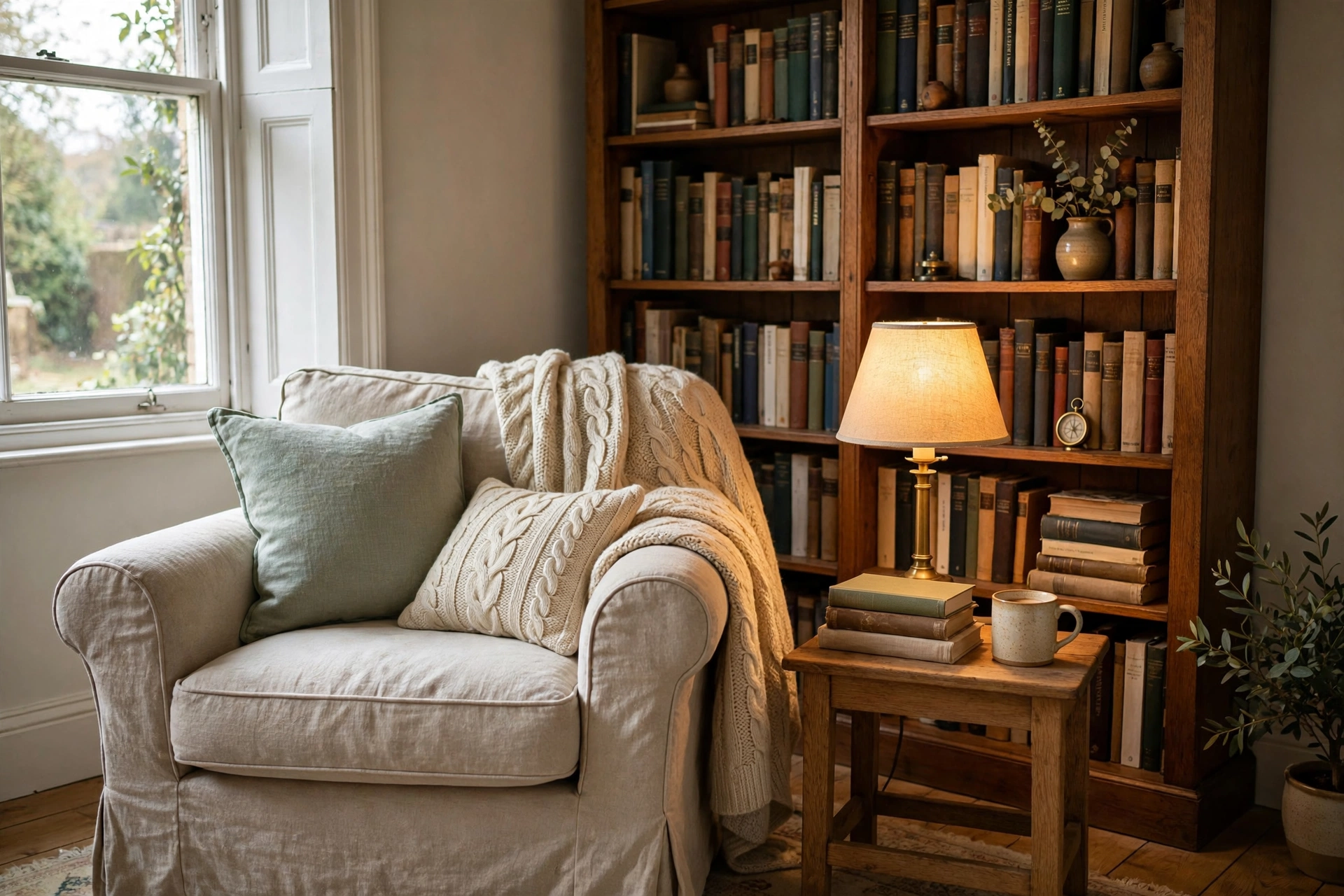
Short answer: A cosy reading corner needs four things: a comfortable seat with proper back support, warm layered light you can actually read by, soft textiles for warmth, and a small surface within arm’s reach for your book and a brew. A bedroom corner, an alcove, a bay window or even a landing can work — cosiness comes from enclosure and texture, not square footage.
British homes were made for reading corners. Long dark evenings from October to March, draughty Victorian terraces, new-build box rooms, awkward alcoves beside chimney breasts — every one of them hides a spot where a chair, a lamp and a pile of books can turn dead space into the favourite seat in the house. You do not need a library or a big budget. You need the right ingredients, layered in the right order.
What Is a Cosy Reading Corner?
A cosy reading corner is a small, deliberately styled zone dedicated to one activity: settling down with a book. Psychologists call it a “nesting instinct” space — an enclosed, slightly darker spot where the brain feels safe enough to switch off. Design-wise, it is built from the same formula every time: a seat you can sink into, task lighting that falls on the page rather than in your eyes, textiles that hold warmth, and everything you need within one arm’s reach. The corner works because it is separate — even a chair angled into the corner of a room reads as its own little world.
1. Claim the Awkward Alcove
Chimney-breast alcoves in Victorian terraces and 1930s semis are the classic reading-corner real estate. They are usually about 90–120cm wide — too narrow for furniture, perfect for a narrow armchair or a built-in bench. Flank the seat with book storage (floating shelves or two narrow bookcases), add a wall light above at picture height, and the alcove becomes a purpose-built book nook. Paint the alcove walls a shade or two deeper than the room for extra enclosure, as in our dark green living room ideas — the depth makes the corner feel like a room within a room.
2. Turn a Bay Window Into a Seat
The bay window is Britain’s gift to readers. A made-to-measure cushion (foam cut to size at any upholstery shop, covered in washable fabric), a couple of back cushions against the window frame, and a throw — done. The daylight is unbeatable for daytime reading, and the outlook gives your eyes somewhere to rest between chapters. Lift the seat on a shallow storage base and you have solved the toy or bedding storage problem too. Add a small rechargeable lamp for evenings so the nook works after dark, when the window becomes a black mirror.
3. Use the Armchair + Floor Lamp Formula
The foolproof formula, and the one most reading corners reduce to: one genuinely comfortable armchair, one floor lamp arcing over the reading shoulder, one small side table. The lamp matters more than the chair — a standard 60W-equivalent LED bulb in warm white (2700K) at the right height makes a £99 armchair feel luxurious, while the wrong bulb makes a designer chair feel like a dentist’s waiting room. Our warm white vs cool white bulbs guide explains why cool white ruins cosiness. Position the lamp behind and slightly to the side of your non-dominant shoulder, so your reading hand never casts a shadow on the page.
4. Make a Box-Room Nook
Britain’s box rooms — often barely 2 x 2 metres — are too small for much, but a reading nook only needs one corner. A compact tub chair (under 70cm wide) or even a deep floor cushion with a backrest turns the dead corner into a retreat. Keep the palette light and the storage vertical: one tall, narrow bookcase rather than a wide one. This is the same small-space thinking as our small snug ideas — one hero piece, everything else tucked away, nothing blocking the door swing.
5. Steal the Landing or Hallway Corner
That wide bit of landing at the top of the stairs? The dead corner of a long hallway? Both make excellent reading spots because nobody expects them — which means nobody disturbs you there. A slim armchair (under 65cm deep), a wall-mounted swing-arm light to save floor space, and a narrow bookcase along the wall. Hallways have the added advantage of borrowed light from every room off them. Check the idea against our autumn hallway decor ideas for styling that suits a transitional space.
6. Layer the Lighting: A Reading Corner Comparison
One overhead light is the enemy of a reading corner — it flattens everything and throws your own shadow across the page. Layer three types instead:
- Task light (essential): a floor lamp, table lamp or swing-arm wall light aimed at the book. Warm white, 2700–3000K, positioned so the shade’s lower edge sits roughly at shoulder height when you are seated.
- Ambient light (the cosiness layer): fairy lights along a shelf, a candle-style LED on the side table, or the spill from a nearby room. This is what makes the corner glow rather than glare.
- Daylight (free, and best): if the corner has a window, orient the chair to take it — daylight at 5000K+ keeps eyes fresh far longer than any bulb.
For evening sessions, a dimmable bulb is worth every penny: full brightness for the first chapters, dimmed low for the last sleepy pages. Dunelm, The Range and IKEA all sell dimmable warm-white bulbs for a few pounds.
7. Pile On the Textiles
Textiles are what turn “a chair in a corner” into “a reading corner”. The recipe: a chunky-knit or waffle throw over the chair arm, two cushions (one for your back, one for your lap or to hug), and a rug underfoot so your feet never touch cold floorboards. Natural fibres — wool, cotton, linen — feel warmer and age better than polyester. Autumn is the season to raid the high street: Dunelm‘s teddy and boucle throws, B&M‘s seasonal fleece range, and Homesense‘s one-off textured cushions all deliver the layered look for very little money.

8. Keep a Surface Within Arm’s Reach
Every reading corner needs somewhere for the book you are not holding, the mug, the glasses and the phone you are pretending not to check. A C-shaped side table that slides over the chair arm is the space-saving champion; a small wooden stool or a stack of beautiful books works in a pinch. Renters who cannot drill: a slim leaning shelf or a freestanding narrow side table gives you the surface with zero wall damage. The rule is arm’s reach — if you have to stand up for your tea, the corner is not finished.
9. Build the Books In
A reading corner without books nearby is just a chair. You do not need a full library: a single cube shelf (IKEA KALLAX, endlessly customisable), two or three floating shelves, or a small bookcase turned sideways as a side table all keep the current reads close. Style shelves with books facing both ways — spines out for the ones you love, covers out for the pretty ones — and leave a little breathing room between stacks. One trailing plant (pothos survives everything) softens the geometry.
10. Warm the Corner With Colour
Colour is the cheapest transformation in the book. Painting just the corner’s walls — or papering one wall — in a warm, enveloping shade makes it feel separate and intentional. Think warm neutrals with depth: Dulux Warm Truffle, Farrow & Ball Dead Salmon, or a soft ochre. Deep green works beautifully too, wrapping the corner like a snug (see our dark green living room ideas). For winter especially, warm tones counteract the blue-grey daylight and make lamplight feel golden. Renters: a large piece of art or a fabric wall hanging in a warm tone does 70% of the same job.
11. The Renter-Friendly Reading Corner
No drilling, no painting, no problem. A freestanding bookshelf as a room divider creates the enclosure; a plug-in floor lamp with a footswitch avoids wiring; a large rug defines the zone; floor cushions or a beanbag-style lounger replace the armchair. Peel-and-stick LED strip lights behind the shelf give you the ambient layer with zero damage. When you move, the whole corner packs into two boxes — the ultimate portable luxury.
12. Edit, Then Personalise
The final step is subtraction. A reading corner drowns in clutter faster than any space in the house — the side table accretes mugs, the shelf fills with books you will never open. Keep the current read, one “next up”, the lamp, the throw. Then add one personal thing: a framed print, a candle in a scent you love, a small plant. Cosy is a feeling, and feelings come from the personal touches, not the shopping list. If the corner still does not feel right, the answer is almost always more light layers or one more textile — never more stuff.
A Quotable Truth About Reading Light
Lighting designers recommend positioning a reading lamp so its shade sits at about shoulder height when you are seated, with the light falling over the shoulder opposite your dominant hand. Get that one detail right and you can read for hours without eye strain; get it wrong and even the perfect chair will not save the corner. Light placement is the whole game.
Frequently Asked Questions
Where is the best place for a reading corner in a small UK home?
The best spot is an underused corner with natural boundaries: a chimney-breast alcove, a bay window, a box-room corner, or a wide landing. Enclosure matters more than size — a 1 x 1 metre alcove with a chair, lamp and shelf will feel cosier than a big open area. Look for the spot nobody sits in; that is your corner.
What lighting is best for a reading corner?
A dedicated task light — floor lamp, table lamp or swing-arm wall light — with a warm-white bulb (2700–3000K), positioned behind and to the side of your non-dominant shoulder. Add an ambient layer (fairy lights or candles) for atmosphere, and use daylight whenever it is available.
How do I make a reading corner cosy on a budget?
Start with what you have: any comfortable chair, a lamp you already own, and a throw. Then add one rug underfoot (warm feet change everything) and one small side table. Budget heroes include B&M fleece throws, The Range fairy lights, IKEA KALLAX cubes for book storage, and charity-shop side tables.
What is the best chair for a reading nook?
One you can sit in for two hours without fidgeting: proper back support, arms at the right height for holding a book, and a seat deep enough to tuck a leg under. Tub chairs suit small corners; wingbacks suit draughty rooms; a deep floor cushion with a backrest works where space is truly tight. Always sit-test before buying.
A reading corner is the rare home project that pays you back every single evening — in winter especially, when the lamps are on by four and the rain is doing its thing outside. Start with the chair and the lamp, layer the textiles, and link it to the rest of your home with ideas from our cosy living room ideas for winter. For styling the whole corner on a shoestring, see our B&M home decor finds.