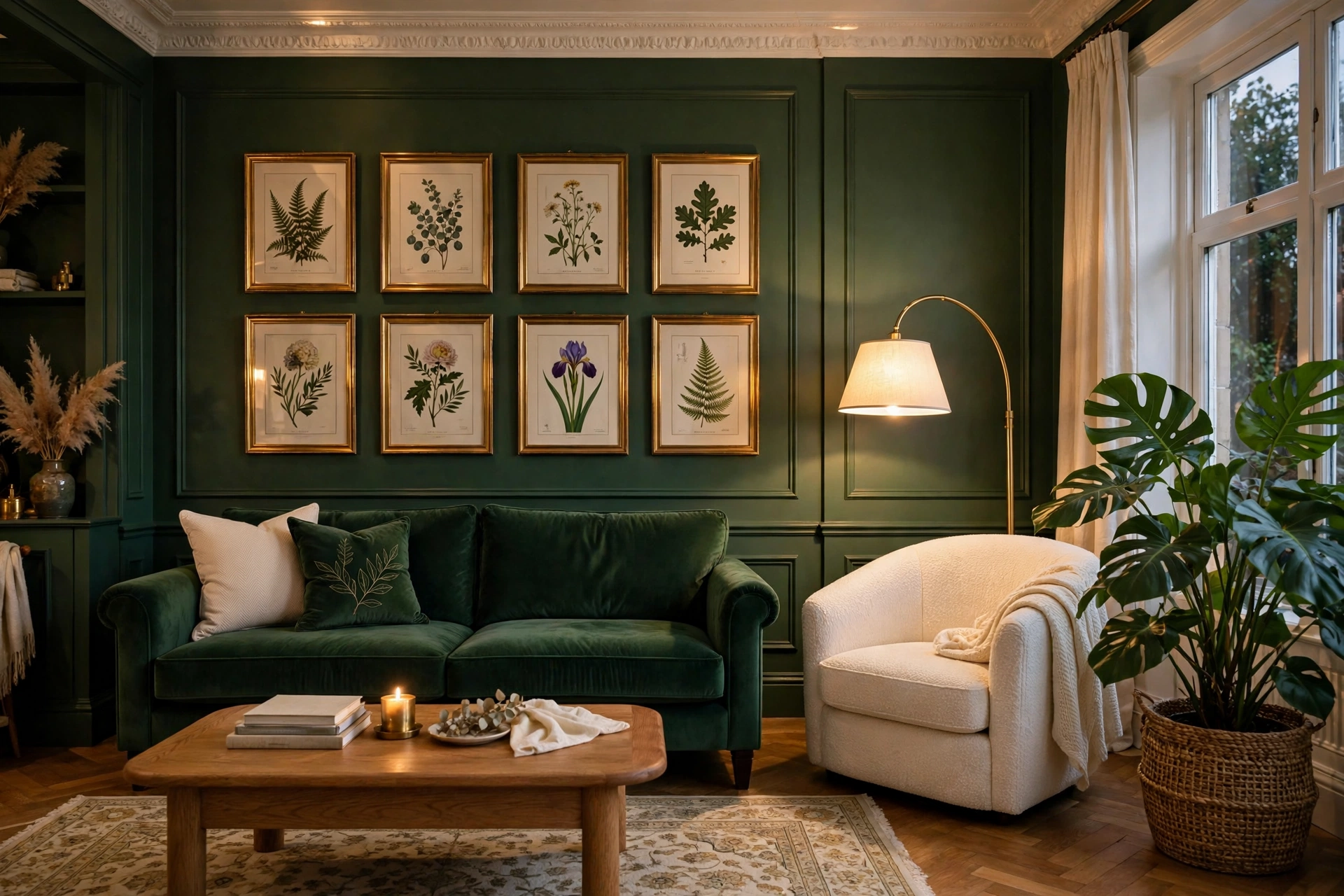
Short answer: Dark green living rooms work because green sits at the middle of the colour spectrum — rich yet restful. Paint all four walls (or one feature wall) in a deep botanical green, pair it with warm woods, brass accents and cream textiles, and layer warm-white (2700K) lighting at several heights. Because dark greens absorb most of the light that hits them, lighting and contrast are what keep the room rich rather than gloomy.
Dark green has quietly become the defining wall colour of the British living room. It began in Victorian-inspired renovations — deep botanical greens look born beside original fireplaces and cornicing — and has spread to new builds and flats everywhere. Done well, a dark green living room feels cocooning in winter and elegant year-round. Done badly, it feels like a cave. The difference is not the paint; it is what you put with it.
What Is a Dark Green Living Room?
In design terms, it is a room painted in deep, botanical greens — forest, moss, olive, near-black green — shades drawn from nature, not neon. The look is rooted in biophilic design (natural colours calm us) and in Britain’s own heritage palette: Victorian villas were often decorated in deep greens and reds. Green carries a whisper of warmth from its yellow undertone, which is why it pairs so happily with oak floors, brass fittings, wool textiles and houseplants.
The Best Dark Green Paints in the UK
The exact shade matters enormously. The tried-and-tested favourites:
- Farrow & Ball Studio Green No.93 — the darkest, almost black in low light; dramatic and cocooning
- Farrow & Ball Green Smoke No.47 — a softer, smoky sage-olive; most forgiving for smaller rooms
- Farrow & Ball Bancha No.298 — a deep, rich olive with real depth
- Farrow & Ball Calke Green No.34 — a botanical green that shifts beautifully between daylight and lamplight
- Dulux Emerald Glade — a rich jewel green; widely available and easier on the budget
Always paint large tester swatches on two walls and live with them for 48 hours — a green that looks perfect in the shop can turn muddy or teal in north-facing light.
1. Commit to All Four Walls
The most transformative move is the simplest: paint all four walls. One green wall with three white ones reads as an accent; four green walls read as a room. The colour wraps around you, corners disappear, and the space feels intentionally cocooning. It works best with decent ceiling height and at least one good window — in small or north-facing rooms, choose a softer shade like Green Smoke (see idea 13).
2. Or Start With One Feature Wall
Not ready for full immersion? One feature wall behind the sofa or fireplace gives 80% of the drama for a fraction of the commitment — and it is easier to repaint later. Keep the other walls warm white rather than brilliant white: brilliant white next to deep green creates a harsh contrast that cheapens both. Warm whites like Dulux Natural Hessian let the green glow without glaring.
3. Colour-Drench the Ceiling and Woodwork
Colour drenching — walls, ceiling, skirting and even radiators in the same shade — takes a green room from nice to extraordinary. Removing the white ceiling eliminates the visual “lid” that makes dark rooms feel low. Use the same paint in different finishes (matt emulsion on walls, eggshell on woodwork, flat matt on the ceiling) so subtle sheen shifts keep the single colour from feeling flat.
4. Pair Green With Warm Woods
Dark green and wood are a natural marriage — forest and tree trunk. Oak floors, a walnut sideboard, teak mid-century pieces: the wood’s golden undertones play against the green’s coolness perfectly. If your floors are grey laminate or pale carpet, add wood through furniture instead — IKEA‘s solid pine and oak ranges take on a honey tone that sits beautifully against deep green.
5. Add Brass and Gold Accents
Brass is dark green’s best friend. A brass floor lamp arcing over the sofa, brass picture frames, brass handles, a cluster of brass candlesticks on the mantelpiece — each catches the light and glints against the dark walls like jewellery. Keep metal finishes consistent (all brass or all antique gold reads as deliberate), and hunt Homesense and Dunelm for affordable pieces that punch above their price.
6. Soften With Cream and Oatmeal Textiles
Dark walls need light textiles to breathe. Cream, oatmeal, natural linen and warm ivory — in curtains, throws, cushions and rugs — create the contrast that stops a green room feeling heavy. A cream boucle armchair against a Studio Green wall is one of the defining images of current British interiors, and it works because the texture does as much as the colour. Layer natural linens and undyed wools rather than stark whites.
7. Bring In Velvet — Green on Green or Contrast
If any fabric was made for dark green walls, it is velvet. A velvet sofa in the same green family creates tonal, luxurious depth; a velvet armchair in rust, ochre or plum creates the colour tension that makes a room memorable. Velvet’s pile catches light differently from every angle — exactly what dark walls need. Dunelm and DFS both run affordable velvet ranges; a single armchair can change the register of the whole room.
8. Layer Warm Lighting at Three Heights
The non-negotiable idea. Dark green walls absorb the overwhelming majority of the light that hits them, so a green room lit by a single ceiling pendant will always feel gloomy. Layer warm light instead: a floor lamp in the dark corner, table lamps on sideboards, candles or fairy lights at low level — every bulb warm white (2700K), since cool white turns green walls muddy. Our warm white vs cool white bulbs guide covers the detail. Picture lights above artwork are especially effective: warm light washing across a brass frame on a dark wall is pure gallery drama.
9. Hang a Gallery Wall With Brass Frames
Dark green is the finest gallery-wall background there is — the wall itself becomes part of the composition. Botanical prints, vintage landscapes, black-and-white photography and gilt frames all glow against deep green as they never do on white walls.
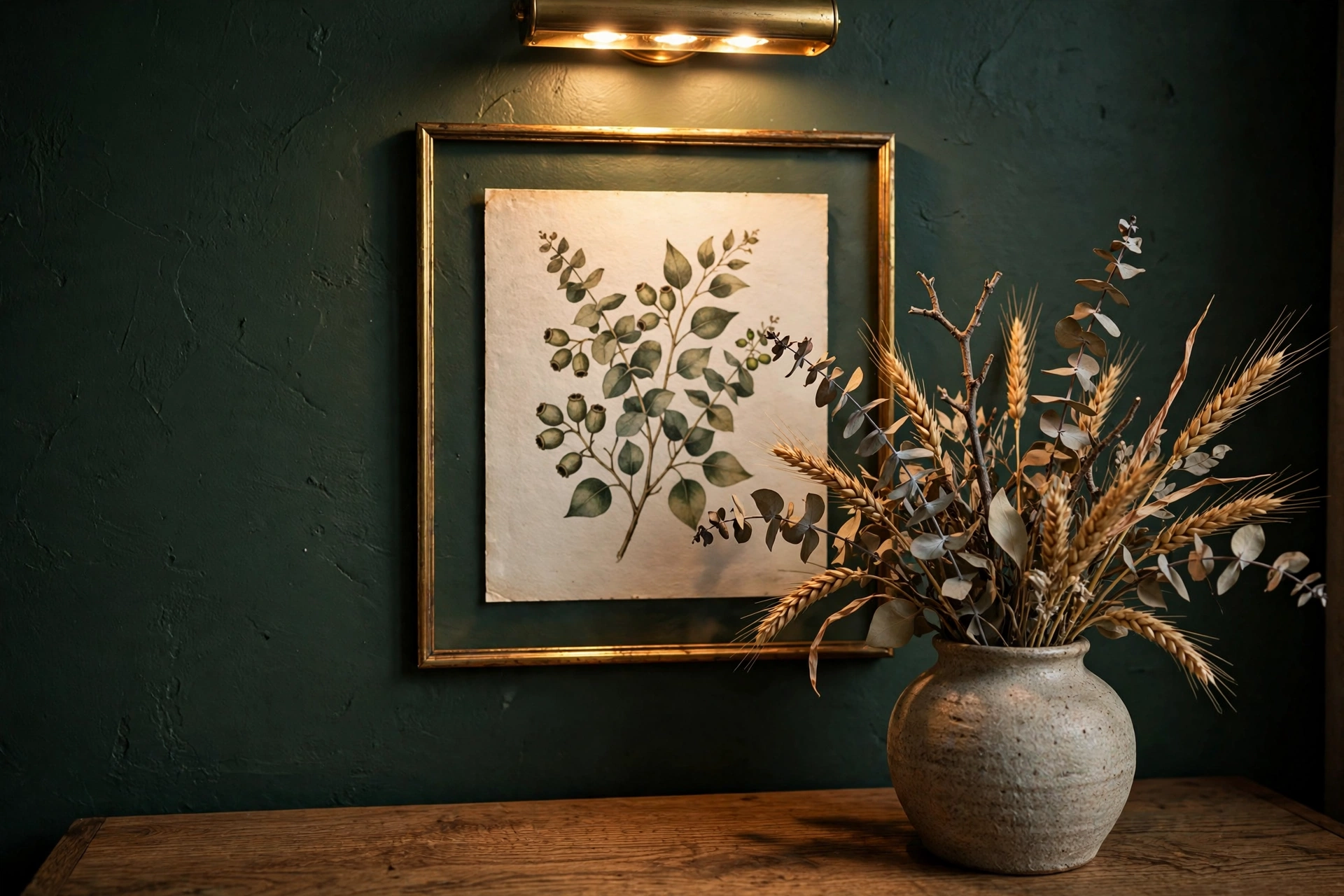
Keep one frame finish dominant (mostly thin brass, one or two wooden), hang the centre of the arrangement at eye level, and include one oversized piece to anchor it. Print shops and charity-shop frames keep the cost well under control.
10. Double Down With Houseplants
Green on green should not work, but it does — spectacularly. A monstera, fern or trailing pothos against dark green walls creates layered, jungle-like depth, making the room feel like a conservatory. Go big rather than scattering small pots: one large fig or palm in a stoneware pot has ten times the impact of five tiny succulents. Variegated leaves with cream markings are especially effective, echoing the room’s light textiles.
11. Add Natural Texture: Rattan, Jute and Wool
Dark green walls love texture — it gives the eye somewhere to go. Rattan pendant shades, a jute rug, woven baskets, a chunky-knit wool throw: each natural material adds warmth and craft that stops the room feeling like a paint sample. Texture is also the budget route: a £15 jute rug from IKEA, a seagrass basket from B&M, a woven shade from The Range all read as expensive because the wall colour does the heavy lifting.
12. Style the Fireplace as the Focal Point
Dark green walls turn a fireplace into a natural altar. Paint the chimney breast the same green (or a shade deeper), dress the mantel with brass candlesticks, a leaning gilt mirror and winter foliage, and let firelight work its magic against the dark walls. No working fire? A mantel shelf styled the same way — or an unused firebox filled with birch logs and lanterns, as in our cosy living room ideas for winter — creates the focal point the room needs.
13. Make It Work in a Small Living Room
The old rule — dark colours shrink small rooms — is only half true. What cramps a room is contrast and clutter, not colour depth. A small living room painted entirely in one deep green, boundaries blurred, can feel larger because the eye cannot find the edges. Conditions: light or mid-tone flooring, a large mirror to double the space, a softer green like Green Smoke, and ruthless decluttering. Our small snug ideas show the same enveloping trick in miniature.
14. The Renter’s Route: Green Without Paint
Renters can get 90% of the look with zero paint: one very large piece of dark green art (or a peel-and-stick mural), green velvet cushion covers and a throw, a green ottoman or armchair, and trailing plants. The eye reads “green room” from the accumulation. Peel-and-stick murals have improved enormously — test a patch behind furniture first, and keep the backing paper for the deposit.
15. Start Small: Painted Furniture and Tester-Pot Projects
Let furniture carry the colour first: a bookcase, sideboard or dining chairs painted in Studio Green or Bancha gives you the trend’s depth for the price of a tin of paint — and it is far easier to change your mind about than four walls. One weekend project, under £40, and you will know whether you love living with the colour at wall scale.
A Quotable Truth About Dark Green
Deep green paints typically reflect barely a tenth of the light that hits them, absorbing the rest. That is why dark green rooms live or die by their lighting — warm, layered light at several heights does not just decorate a green room, it reveals it. Get the light right and the walls glow like a forest at dusk; get it wrong and no amount of brass will save the gloom.
Frequently Asked Questions
What is the best dark green paint for a living room in the UK?
Farrow & Ball Studio Green No.93 for maximum drama, Green Smoke No.47 for smaller or darker rooms, and Bancha No.298 for rich olive depth. On a budget, Dulux Emerald Glade gives comparable jewel-green richness. Test large swatches on two walls for 48 hours first.
What colours go with dark green walls?
Warm woods (oak, walnut), brass and antique gold, cream and oatmeal textiles, and accents drawn from nature: rust, ochre, plum, terracotta. Keep other walls warm white, and avoid cool greys and chrome, which fight the green’s warmth.
Does dark green make a living room look smaller?
Not necessarily — contrast and clutter shrink rooms, not colour depth. Painting walls and ceiling in one deep green blurs boundaries and can make a small space feel larger. Choose a softer green like Green Smoke for compact rooms, keep flooring light, and add a large mirror.
Is dark green still in style for living rooms?
Yes — it has moved from trend to modern classic in UK interiors. Rooted in Victorian heritage palettes and biophilic design, it suits period and new-build homes alike, ages gracefully, and repaints easily if tastes change.
Dark green is the rare colour that makes a living room feel both dramatic and restful — richer in winter lamplight, calm in summer daylight. Start with the lighting, commit to the shade, and let brass, wood and cream do the talking. For the full winter layering treatment, see our cosy living room ideas for winter — and for getting the bulbs right, the warm white vs cool white guide.