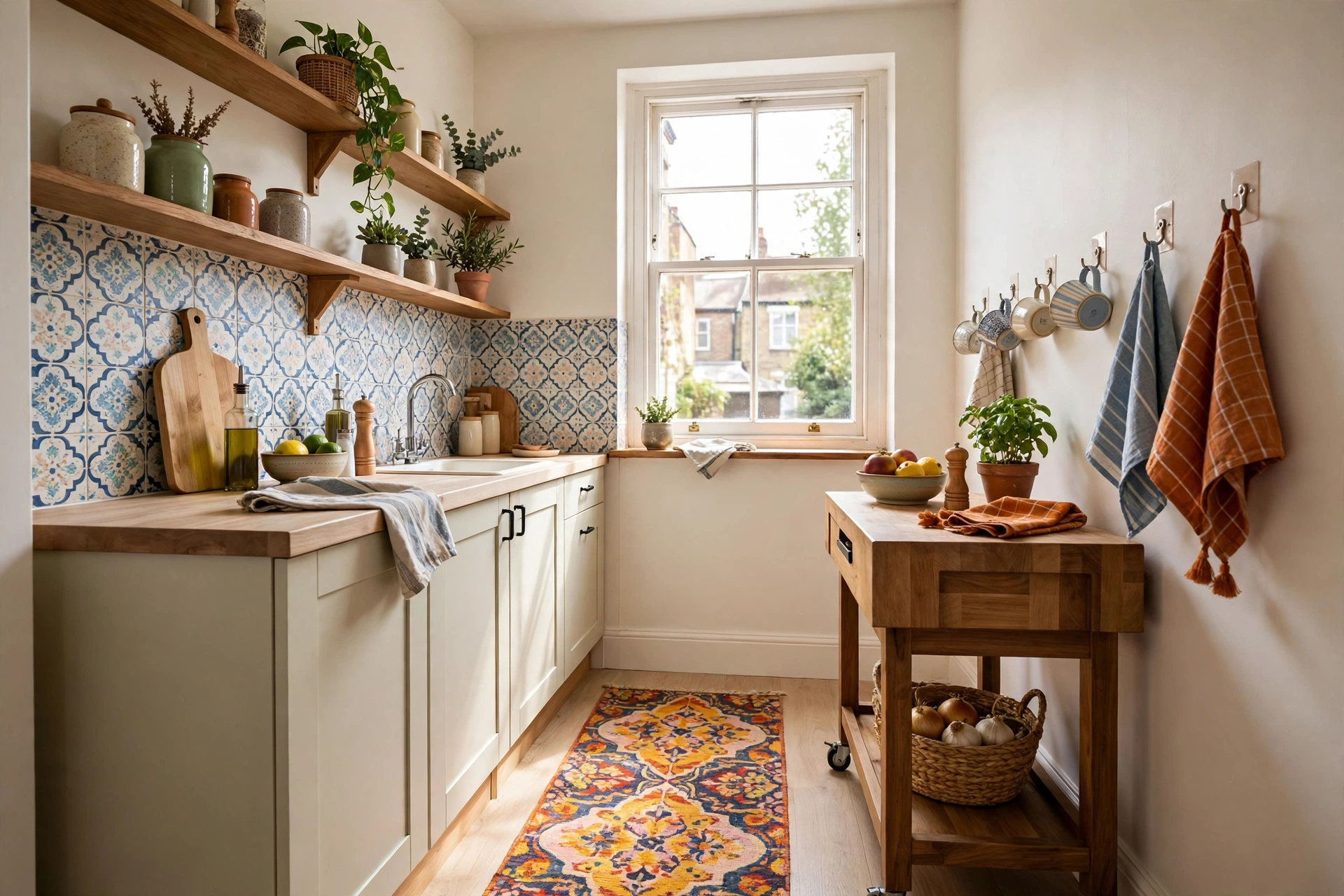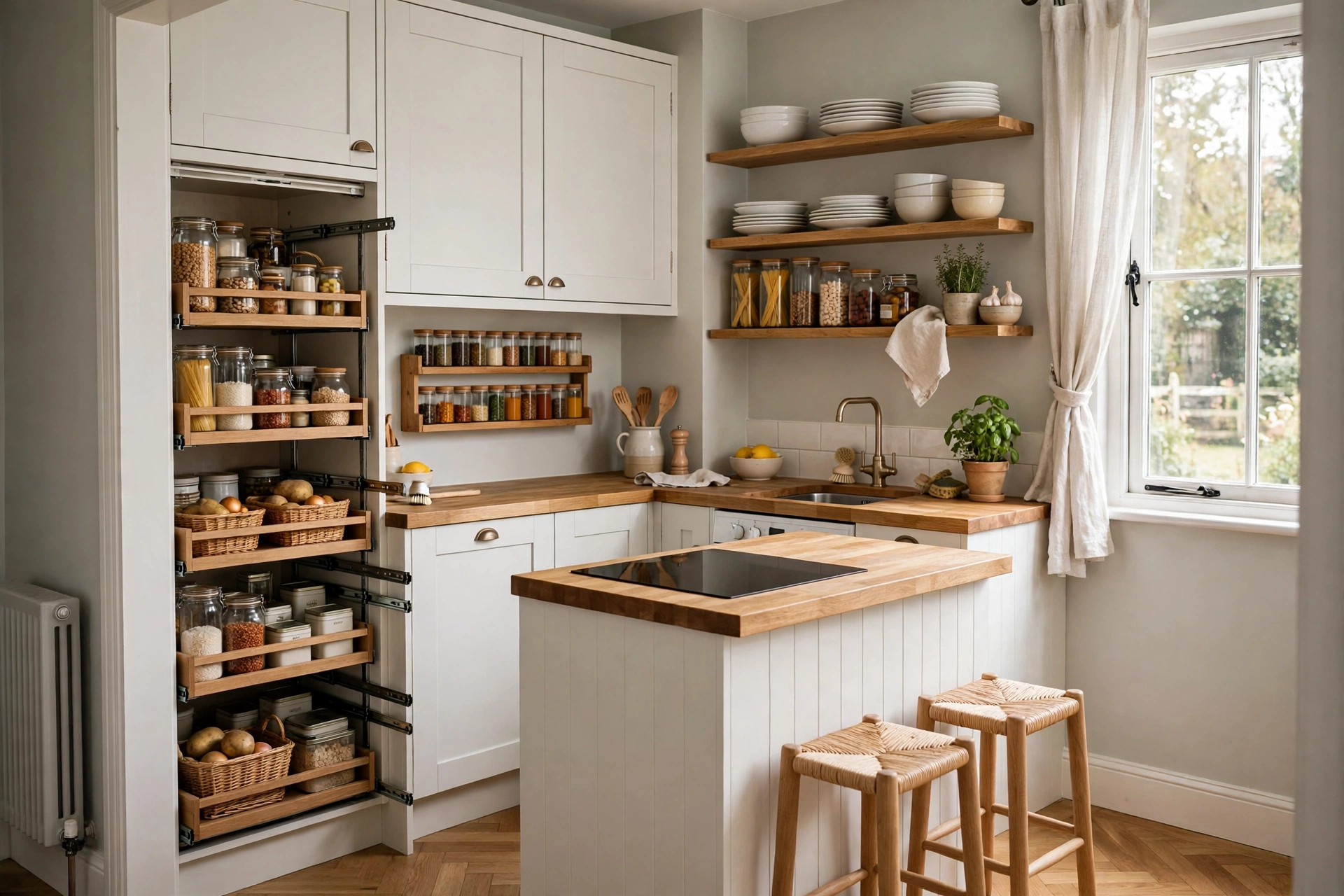
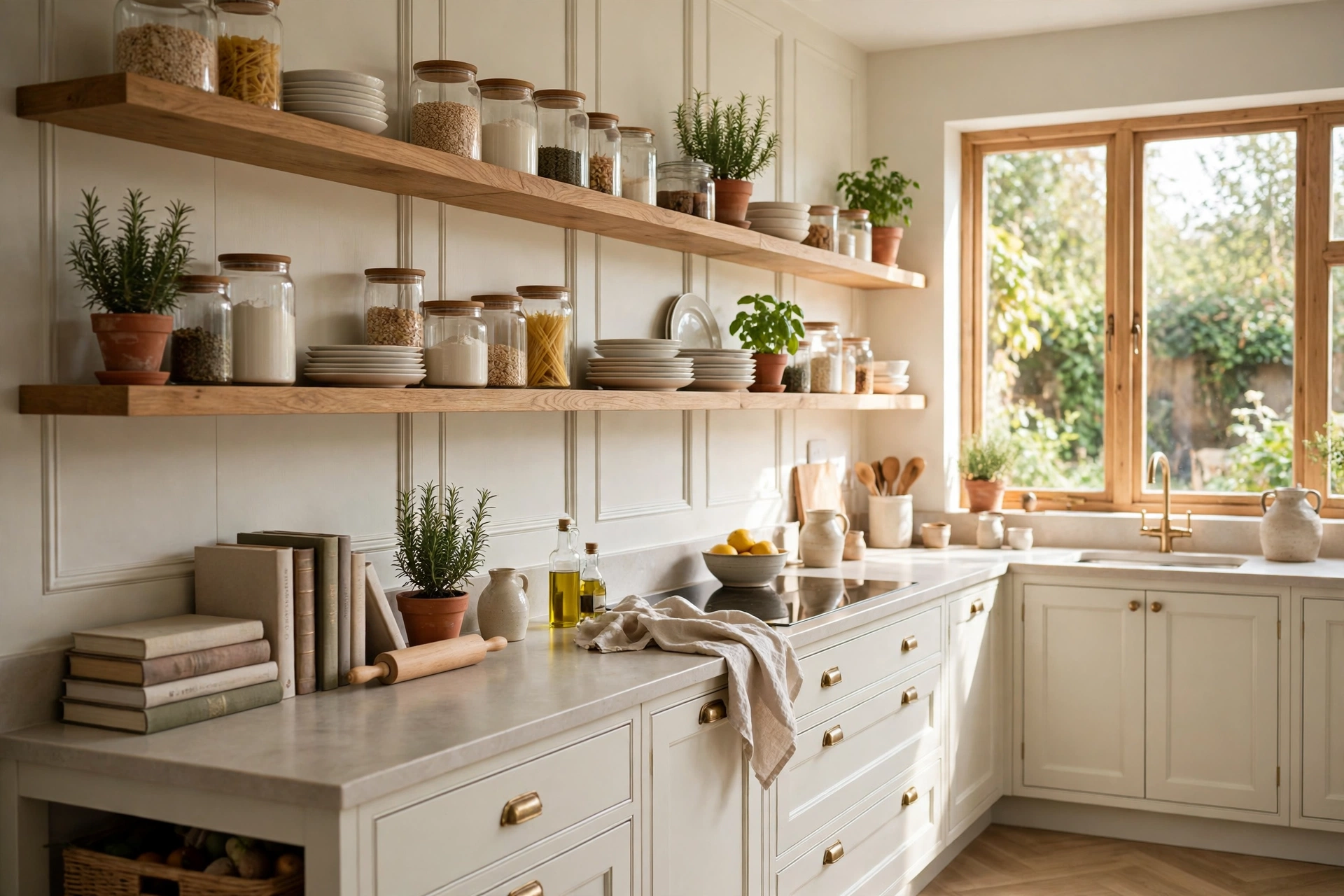
Short answer: Style open kitchen shelves by grouping everyday items in odd numbers, mixing heights and textures, and leaving plenty of breathing space. Keep the pieces you use daily within easy reach, put display-only items higher up, and stick to a simple colour palette of two or three tones so the shelves look calm rather than cluttered. A tidy open shelf makes even a small UK kitchen feel bigger and brighter.
What Are Open Kitchen Shelves?
Open kitchen shelving means wall-mounted shelves with no doors, so everything stored on them stays visible. Unlike fitted wall cabinets, which hide their contents, open shelves turn everyday crockery, glassware and cookbooks into part of the room’s decoration. The style suits Victorian terraces, Edwardian flats and new build kitchens alike, and it works well in small UK kitchens where closed cabinets can make the walls feel heavy. A single run of oak or painted shelves above a worktop can replace one or two wall units without any building work.
Why Open Shelves Work So Well in UK Kitchens
British kitchens are often smaller than those in newer homes overseas, and open shelving helps in three practical ways. First, it removes the visual bulk of wall cabinets, so light travels further and the room feels wider. Second, it puts the things you reach for every day, mugs, bowls, olive oil, right where you can see them, which speeds up cooking. Third, it costs far less than fitted units: a pair of solid oak floating shelves from a UK retailer such as IKEA, Dunelm or B&M typically costs a fraction of a single wall cabinet, and fitting them is a Saturday afternoon job with a spirit level, a drill and the right wall fixings.
There is one honest trade-off. Open shelves show dust and grease, so they suit households happy to wipe them down weekly. If you rarely dust, keep open shelving to one short run and leave the rest of the kitchen closed.
Open Kitchen Shelf Styling Ideas That Always Work
Good shelf styling follows a few simple rules, and once you know them you can restyle a shelf in ten minutes. The ideas below work in a compact flat kitchen or a large family space.
1. Stack Everyday Plates and Bowls
Stack white or cream plates in short piles of four to six, with bowls on top. Matching crockery looks calm, while a single accent colour, sage green or soft grey, adds interest without chaos. Keep the stacks near the dishwasher or the table so putting things away stays easy.
2. Group in Threes and Fives
Odd-numbered groups look more natural than even ones. Try three glass jars together, or five small bowls in a row. This old stylist’s trick works because the eye reads odd groups as relaxed and collected rather than lined up like soldiers.
3. Mix Heights and Shapes
A flat row of same-height objects looks like a shop shelf. Mix a tall vase, a medium jug and a low stack of bowls, and vary the shapes: round plates beside a rectangular chopping board, a tall bottle beside a squat jar. The change in height keeps the eye moving along the shelf.
4. Add Something Living
A small potted herb, basil, mint or rosemary, brings colour and scent, and you can snip it straight into dinner. Trailing plants such as pothos soften the straight lines of shelving, and they cope well with kitchen humidity. Keep plants in a simple pot that matches your palette.
5. Layer Chopping Boards Behind
Lean wooden chopping boards upright at the back of the shelf, with smaller items in front. The wood adds warmth, fills the vertical space, and hides the wall behind. Oak, beech and bamboo boards all work, and they are useful as well as decorative.
6. Use Glass Jars for Dry Goods
Decant pasta, rice, flour and lentils into clear glass jars with wooden or metal lids. The contents become a display in their own right, and you can see at a glance what needs topping up. Kilner-style jars from The Range or Homesense are a budget-friendly starting point.
7. Hang Mugs Underneath
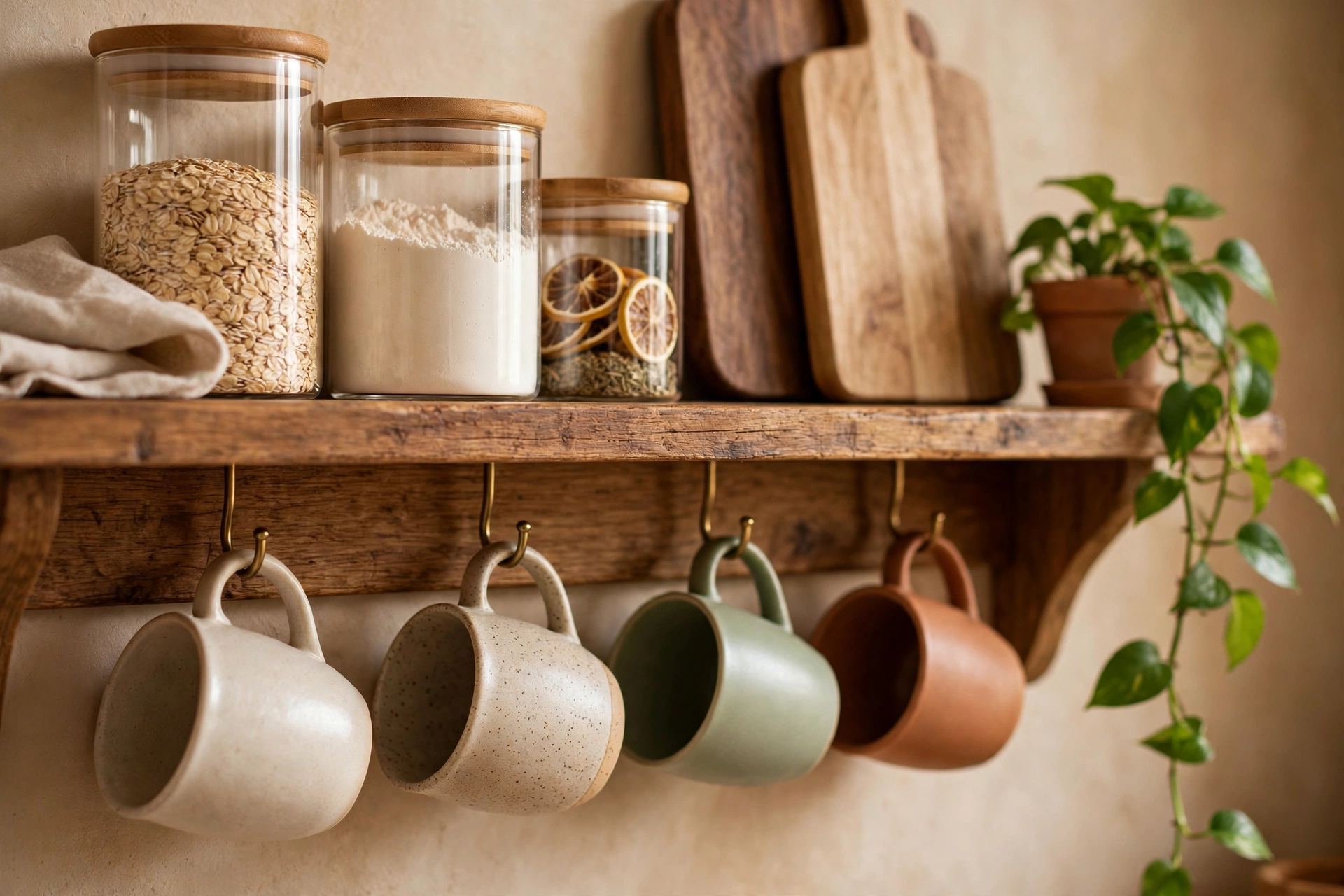
Screw small cup hooks under the lowest shelf and hang mugs by their handles. It frees space on the shelf itself and turns a plain row of mugs into a feature. Keep to four or six matching mugs for a tidy look.
8. Leave Breathing Space
The most common styling mistake is filling every centimetre. Leave at least a third of each shelf empty. Empty space is what makes a shelf look styled rather than stuffed, and it leaves room for a seasonal piece.
9. Repeat a Colour Twice
Pick two or three colours and repeat each one at least twice across the shelves. A terracotta pot on the top shelf and a terracotta dish on the bottom ties the whole run together. Neutrals, white, cream, natural wood and soft grey, make the easiest base, with one accent colour for personality.
10. Style the Top Shelf as a Display
The highest shelf is hard to reach, so use it for display only: a favourite jug, a framed print, a stack of cookbooks or a vase of dried stems. Keep everyday items on the middle and lower shelves where you can grab them without a step stool.
Open Shelves vs Wall Cabinets: Which Is Better?
Neither option wins outright, and many of the best UK kitchens mix the two. This comparison should help you decide how much open shelving suits your home.
- Cost: open shelves are far cheaper. A pair of floating shelves costs roughly the price of one budget wall cabinet, before fitting.
- Storage: wall cabinets hold more and hide clutter. Open shelves hold less per metre because items need space around them to look good.
- Access: open shelves are faster. You can see and grab a mug in one movement, with no door to open.
- Cleaning: cabinets win. Open shelves collect dust and cooking grease and need a weekly wipe.
- Light: open shelves let more light into the room and make small kitchens feel bigger.
- Flexibility: shelves are easy to move or remove, which suits renters and anyone who likes to refresh their kitchen often.
A practical compromise is one run of open shelves for daily items and display, with closed cabinets everywhere else. You get the light, airy look without giving up hidden storage for the less photogenic essentials.
What to Put on Open Kitchen Shelves
Choose items that are both useful and good-looking: white or neutral crockery, clear glassware, wooden boards and utensils, cookbooks with attractive spines, glass storage jars, small plants and a single decorative piece such as a vase or a ceramic jug. Everyday mugs, bowls and plates belong on open shelves because they get used, washed and rotated, which stops them gathering dust.
Leave off the shelf anything you would rather not look at: mismatched plastic containers, cleaning products, packets with loud branding, and chipped or stained items. If a piece is not pretty enough to display, it belongs inside a cupboard. The same rule applies to anything you rarely use: it will only gather dust on an open shelf.
How to Style Open Kitchen Shelves Step by Step
- Empty the shelves completely and give them a good clean. Starting from bare wood makes styling far easier.
- Sort everything into three piles: daily use, display only, and cupboard. Only the first two piles go back on the shelves.
- Place the biggest items first. Put tall boards, large jugs and stacked plates at the back and at the ends, where they anchor the arrangement.
- Build small groups of three or five in front of the larger pieces, mixing heights, shapes and textures.
- Add one living or natural element, a herb pot, a trailing plant or a wooden bowl of fruit, to soften the hard lines.
- Step back and check the balance. If one end looks heavier than the other, move a tall item across. If a shelf looks crowded, remove one thing rather than adding another.
- Live with it for a week and adjust. The items you reach for will show what belongs within easy reach.
Styling Open Shelves in Small Kitchens and Flats
Small kitchens benefit most from open shelving, but they also punish clutter fastest. In a flat or a galley kitchen, keep to one or two short runs, ideally above the worktop where wall cabinets would normally sit. Use the same light colour on the shelves as on the walls, white, pale grey or a soft sage, so the shelves blend in rather than chop up the wall. Avoid deep shelves in narrow kitchens: a depth of 20 to 25 cm holds plates and mugs comfortably without jutting into the room. If you are renting, look for no-drill shelf brackets or a freestanding shelf unit, and see our renters friendly kitchen decor ideas for more landlord-safe options. For more ways to squeeze storage from a tight space, our small kitchen storage ideas guide covers cupboards, corners and awkward gaps.
Keeping Open Shelves Clean and Dust Free
A weekly wipe with a damp microfibre cloth keeps shelves and their contents fresh. In a kitchen with a hob nearby, a light film of grease can build up, so wipe the shelf surface and the tops of jars and boards every week, and wash rarely used items once a month. A small extractor fan used every time you cook makes a real difference. If dust is a constant battle, keep small decorative objects low: every extra ornament is another surface to clean. A good rule is that anything on an open shelf should either be used weekly or be easy to wipe in seconds.
Where to Buy Open Shelves and Styling Pieces in the UK
You do not need a big budget to get the look. IKEA sells solid pine and oak floating shelves, and its jars suit decanted dry goods. Dunelm has a wide range of oak and painted shelves plus ceramic storage and herb pots. B&M and The Range are the best bets for budget glass jars, mugs and small plants, while Homesense is worth a browse for one-off ceramic jugs and unusual vases. For paint, Farrow & Ball and Dulux both offer kitchen-friendly eggshell finishes in soft neutrals. Before you buy, measure the wall, check what it is made of, and buy fixings rated for the weight: plasterboard needs specialist fixings, while a solid brick wall takes standard wall plugs and screws.
Frequently Asked Questions
Are open kitchen shelves practical?
Yes, for the items you use every day. Plates, bowls, mugs and glasses stay within easy reach and get washed often enough that dust is rarely a problem. They are less practical for rarely used items or for storing cleaning products, which are better kept behind a cupboard door.
How deep should open kitchen shelves be?
A depth of 20 to 25 cm suits most kitchens. That is deep enough for a dinner plate, which is usually around 27 cm across if stood on its edge or stacked flat, and shallow enough that the shelf does not jut into the room. For a small galley kitchen, stay at the shallower end of the range.
How do I stop open shelves looking cluttered?
Leave at least a third of each shelf empty, stick to two or three colours, and group items in odd numbers. Remove anything chipped, mismatched or rarely used, and keep small decorative objects to one per shelf. If a shelf still looks busy, take one item away and live with the gap for a few days.
Can I put open shelves in a rented flat?
Usually yes, with your landlord’s permission for drilling. Many landlords accept two small screw holes that can be filled later. If drilling is not allowed, use a freestanding shelf unit, a leaning ladder shelf, or adhesive brackets rated for light loads, and keep heavy items on the worktop instead.