
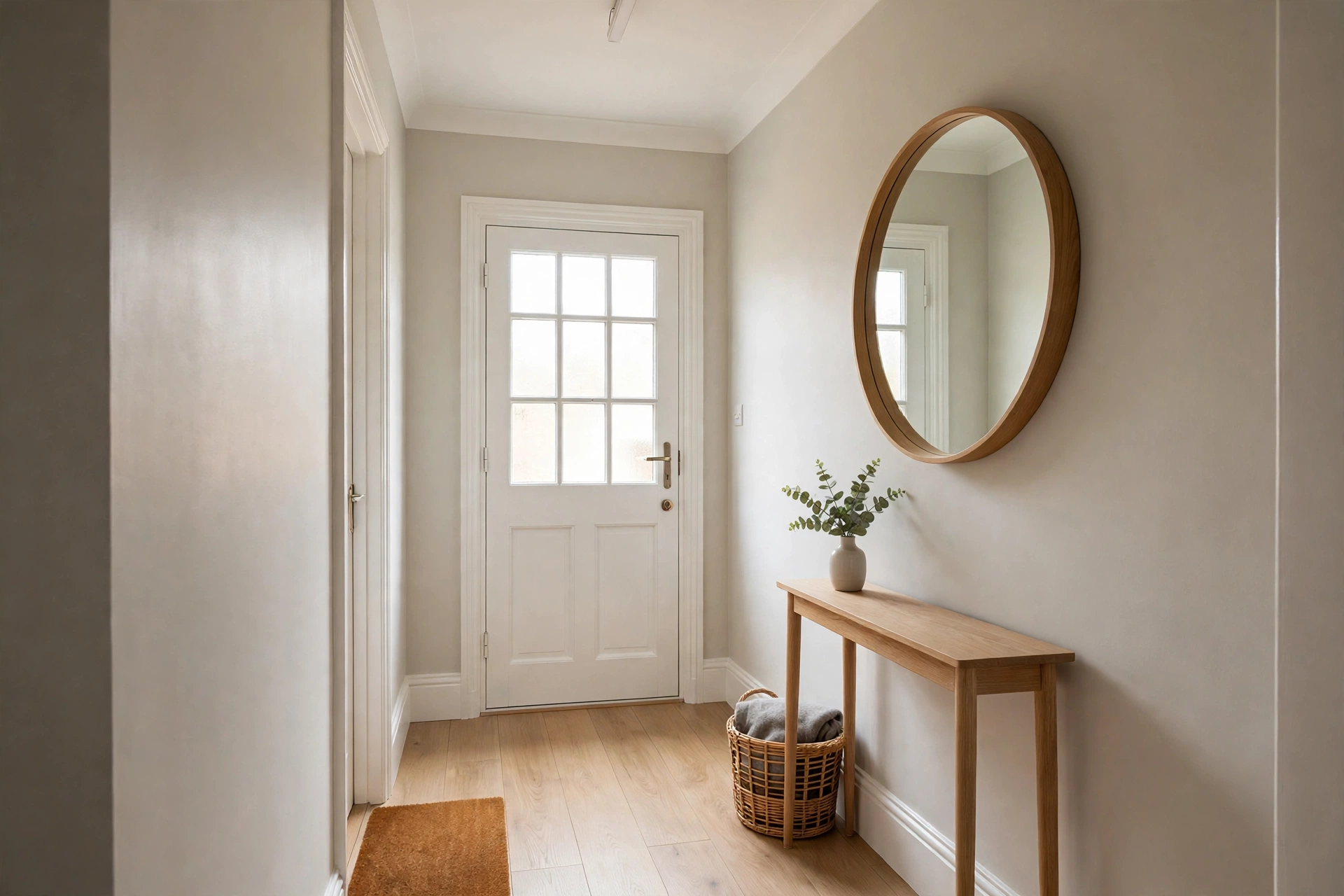
Short answer: The best colour for a dark hallway is a warm white or pale neutral with a high light reflectance value, such as a soft jasmine white, a pale greige or a light warm grey. These shades bounce the limited light around the space instead of absorbing it. Combine them with a satin or eggshell finish, bright white woodwork and a large mirror, and even a windowless hallway can feel bright and welcoming.
Hallways are the hardest rooms in a British home to decorate. They are often long, narrow and starved of daylight, squeezed between rooms with a front door at one end and a staircase blocking the light at the other. In a Victorian terrace the hallway may have no window at all, and in a modern flat it is often just a corridor off the living room. Paint is the most powerful tool you have for fixing that gloom, and it costs far less than new lighting.
The trick is not simply to reach for the brightest white on the shelf. The wrong white can look cold, grey and flat in a space with no daylight, while the right warm neutral can make the same hallway feel calm, bright and far more generous. This guide explains which colours genuinely work in a dark hallway, which finishes bounce the most light around, and the colours to avoid.
What Counts as a Dark Hallway?
A dark hallway is any entrance hall, corridor or landing that receives little or no direct daylight. Common causes include a north-facing front door, a solid door with no glazed panels, a staircase that blocks the light, or a hallway buried in the middle of a flat with no windows. Victorian terraces often have long, narrow halls lit only by a fanlight above the front door, while new build homes frequently have internal hallways with no natural light source at all.
Paint companies measure how much light a colour reflects using light reflectance value, or LRV. The scale runs from 0, which absorbs almost all light, to 100, which reflects almost all of it. A brilliant white sits close to 90, a pale cream around 80, a mid grey near 40 and a deep navy below 10. As a rule of thumb, colours with an LRV above 70 will help a dark hallway feel brighter, while anything below 40 will make it feel smaller and gloomier. Dulux, Farrow & Ball and Little Greene all publish LRV figures, so you can check before you buy.
The Best Colours for a Dark Hallway
These six shades are the most reliable choices for a gloomy UK hallway. All have a high LRV and suit period and modern homes alike.
- Warm white: The safest choice of all. Shades such as Dulux Jasmine White or Farrow & Ball Wimborne White have a gentle yellow undertone that stops them looking cold under LED lighting.
- Pale greige: A blend of grey and beige, greige is the modern favourite for hallways because it adds warmth without going yellow. It works beautifully with light wood floors and oak doors, and hides scuffs better than pure white.
- Soft pale grey: A light warm grey with an LRV above 70 keeps the hallway feeling airy while adding more character than white. Avoid cool blue-greys, which can look chilly in a north-facing hall.
- Pale sage green: A gentle sage is a lovely choice if you want colour without darkness. It feels fresh and calm, and suits cottage hallways and period properties.
- Buttery pale yellow: A soft, pale yellow can warm up a cold north-facing hallway like nothing else. Keep it very pale, more cream than yellow, or it can look dated.
- Light blush or pale plaster pink: A barely-there pink reflects warm light and flatters skin tones, which matters in a space where you greet guests.
Remember: a paint with an LRV above 70 reflects more than 70 percent of the light that reaches it, which is why pale warm neutrals make a windowless hallway feel far brighter than a mid-tone colour.
Warm White vs Cool White: Which Works Better?
Not all whites are equal, and the difference matters enormously in a dark hallway. A cool white with blue undertones looks crisp in a sunlit room, but with no daylight it can read as grey, cold and almost grubby. A warm white with yellow or pink undertones does the opposite: it softens the gloom and makes the space feel inviting.
Choose warm white if your hallway faces north, has no windows, or is lit mainly by warm white bulbs. Choose a neutral white if it gets some daylight from a glazed front door or a fanlight. Avoid brilliant white, the starkest white on the shelf, unless you are painting a very modern hallway with plenty of artificial light. It also shows every scuff, so in a high-traffic hallway you will repaint sooner.
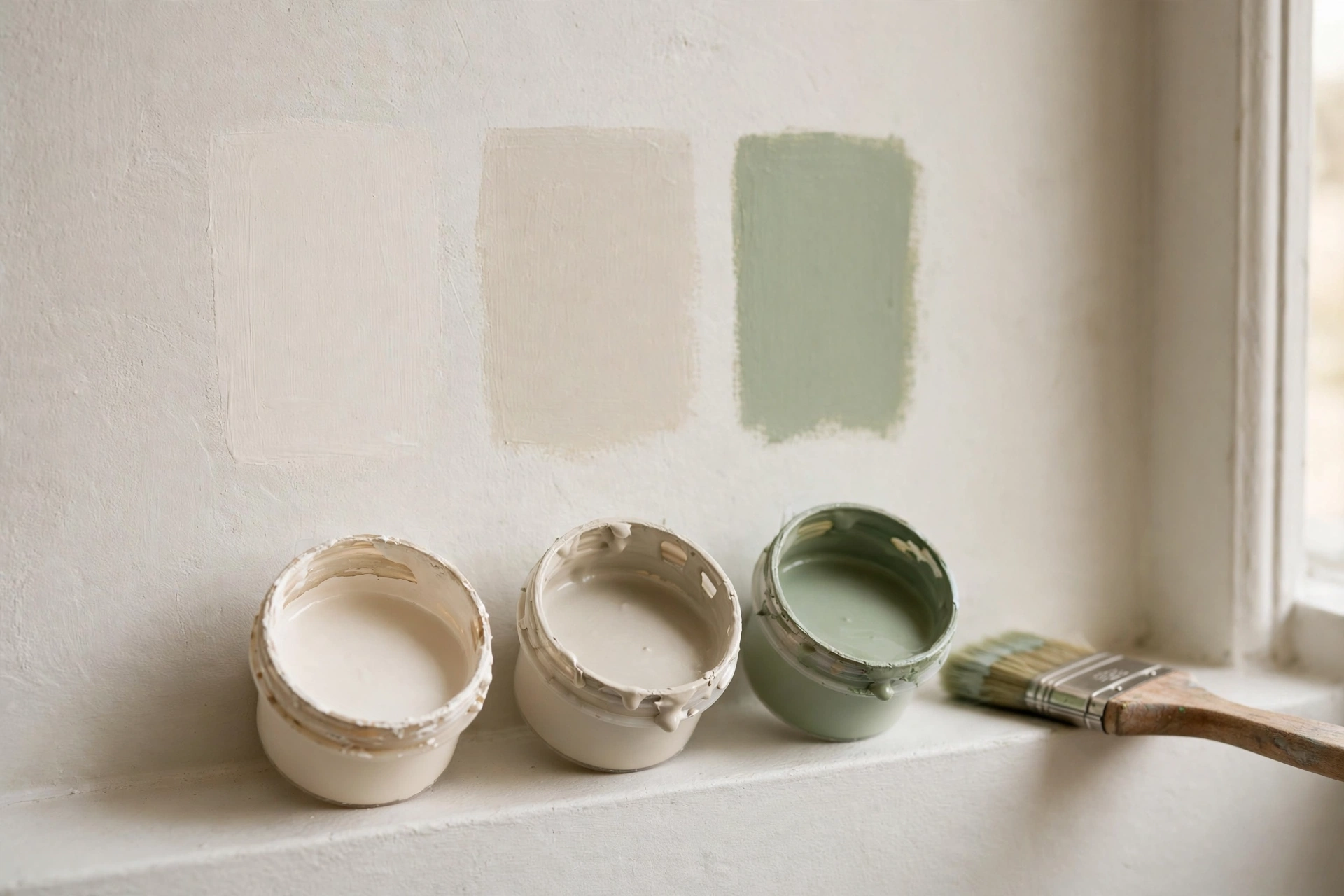
If you are unsure, buy sample pots of two or three whites and paint large swatches side by side on the darkest wall. Live with them for a few days and look at them morning and evening. The right white will look clean and warm at every hour; the wrong one will look grey by lunchtime. For more on the lighting itself, see our guide to small hallway lighting ideas.
The Finish Matters as Much as the Colour
The finish you choose affects how much light bounces around the room. Matt emulsion absorbs light and hides imperfections, which is useful on old, uneven plaster, but it does little to brighten a dark space. Silk and gloss finishes reflect a lot of light but show up every bump and brush mark, which is rarely flattering in a period hallway.
The sweet spot for most dark hallways is an eggshell or satin finish. These sit between matt and silk: they reflect noticeably more light than matt, they are far more wipeable, which matters where bags, coats and shoes brush the walls daily, and they are forgiving enough for older walls. Use eggshell or satin on the walls, and a satinwood or gloss on the woodwork. Painting skirting boards, architraves and doors in a bright white satinwood creates a crisp frame that makes the wall colour look lighter by contrast.
Colour Drenching a Dark Hallway: Does It Work?
Colour drenching, painting the walls, ceiling, woodwork and doors in a single colour, is one of the biggest decorating trends of recent years. In a dark hallway it can work surprisingly well, but only if you choose the right shade. Drenching a hallway in a pale warm neutral makes the space feel seamless and larger, because there are no contrasting edges breaking it up.
What does not work is drenching a dark hallway in a deep, dramatic colour. A dark green or navy hallway can look stunning in a large home with tall ceilings and a glazed front door, but in a small, windowless hall it usually makes the space feel like a tunnel. If you love deep colours, use them as an accent instead: paint the front door a rich green or add a dark console table. You get the drama without losing the light. If you want to see how deep colour works in a room with more light, our dark green living room ideas show the same principle in a brighter space.
Colours to Avoid in a Dark Hallway
Some colours will fight you in a dark hallway, however much you love them on a paint chart:
- Deep navy and charcoal: With an LRV below 10, these absorb almost all available light and make narrow halls feel smaller and colder.
- Dark forest green: Gorgeous in a living room, but in a windowless hallway it can look almost black by evening.
- Cool mid-greys: A grey with blue undertones turns cold and flat without daylight.
- Bright, saturated colours: Vivid reds, oranges and purples bounce coloured light around the space and can make skin tones look odd in the mirror by the front door.
- Chocolate brown: Warm in theory, but it absorbs light, shows dust, and dates a hallway quickly.
That does not mean you cannot use these colours at all. A dark shade on a single feature, such as the inside of the front door, adds depth and character without swallowing the light.
How to Test Paint Before You Commit
Paint charts lie, especially under artificial light. Always test before you buy a full tin. Most UK brands sell 60ml testers for a few pounds at B&Q, Wickes, Dunelm and The Range, so get two or three contenders and paint each one in a patch at least 30cm square on the darkest wall, plus another near the front door. Use two coats, because one coat of a pale colour over a darker wall will mislead you.
Live with the swatches for three days and check them in morning light, evening light and with the hallway lights on. The best colour will look good at every hour. Finally, hold a sample of your flooring or a door offcut against each swatch: a colour that clashes with honey oak or grey carpet will annoy you daily.
Five Cheap Tricks That Make the Paint Work Harder
Paint does the heavy lifting, but these low-cost additions multiply its effect.
- Hang a large mirror opposite the light source: A mirror opposite the front door or a glazed panel doubles the daylight in the hall.
- Paint the ceiling white, always: Even if you colour drench the walls, keep the ceiling a bright white with a high LRV. A white ceiling lifts the whole space and stops it feeling low.
- Keep the flooring light: A pale runner, light wood or pale tiles reflect light upwards onto the walls. Dark carpet absorbs light from both directions.
- Swap to warm white bulbs: Bulbs around 2700K flatter warm neutrals and make the paint look richer. Cool white bulbs can make warm whites look yellow and flat.
- Declutter the walls: A hallway crammed with dark frames, coats and shoe racks will look gloomy whatever colour you paint it. Our Victorian terrace hallway ideas show how period halls stay bright with careful styling.
Finally, remember that paint is only part of the answer. If your hallway still feels dark after painting, a glazed front door panel or a brighter ceiling light will do more than a second coat ever could. For help choosing soft furnishings that keep the light feel going into the next room, see what colour curtains go with grey walls.
Frequently Asked Questions
What is the best colour to paint a dark hallway?
A warm white or pale neutral with a light reflectance value above 70 is the best choice for most dark hallways. Shades such as warm white, pale greige and soft sage reflect the limited light instead of absorbing it. Avoid deep colours and cool mid-greys, which make a windowless hallway feel smaller.
Should I paint a dark hallway white or a colour?
White is the safest option, but a very pale colour often looks better. A pale greige, soft sage or barely-there blush adds warmth and character while reflecting almost as much light as white. The key is to keep the shade pale and warm, whatever colour family you choose.
Does painting the ceiling the same colour as the walls make a hallway darker?
It can do if the colour is mid-toned or dark, because the ceiling absorbs light from above. If you colour drench, use a pale shade so the effect stays bright, or keep the ceiling brilliant white while drenching only the walls and woodwork.
What paint finish is best for a dark hallway?
An eggshell or satin finish is best for most dark hallways. It reflects more light than matt, it is wipeable enough for a high-traffic space, and it is forgiving on older walls. Pair it with satinwood or gloss on skirting boards and doors in bright white to frame the wall colour and bounce even more light around.
