
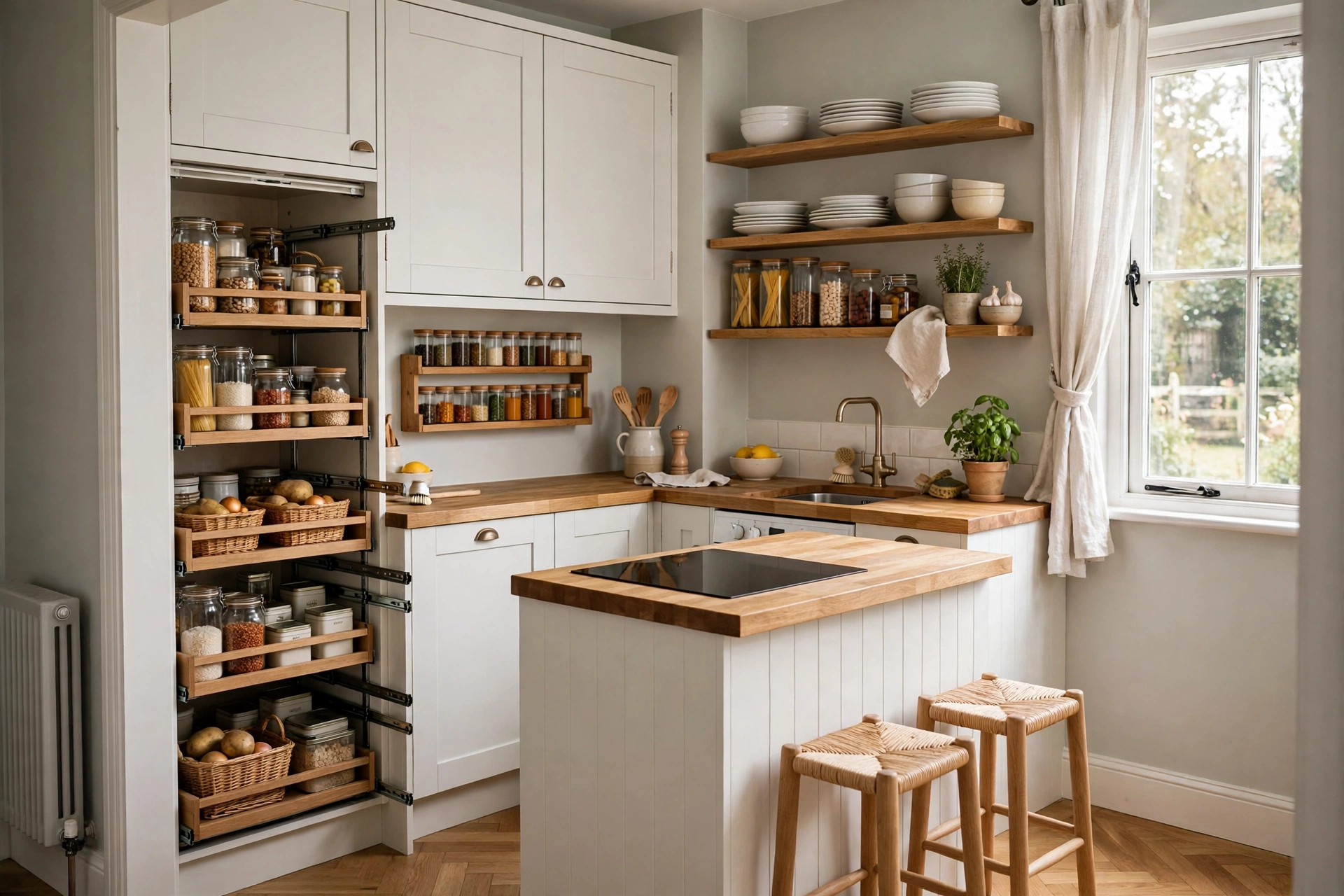
Short answer: The best small kitchen storage ideas in the UK start with using vertical space. Open shelves, wall rails and hooks free up your worktops, while pull-out baskets, door racks and stackable containers can double the usable space inside your cupboards. Most of the fixes below cost under £30 and need no drilling, so renters can use them too.
Small kitchen storage is the art of fitting everything a household needs to cook, eat and clean into a room that was never designed to hold it all. In most British homes, especially flats, Victorian terraces and new builds, the kitchen is the smallest room in the house, yet it has to store food, crockery, pans, cleaning products and small appliances. The goal is not to buy more cupboards. It is to make the space you already have work twice as hard, so that every item has a home and the worktop stays clear enough to actually cook on.
Start by Editing, Not Buying
Before you spend a penny on storage, take everything out of one cupboard at a time and be honest about what you use. Most small kitchens are full of things nobody touches: the bread maker from three Christmases ago, four chipped mugs, a drawer of takeaway menus and a gravy boat with no lid. If you have not used it in a year, it does not earn a place in a small kitchen. Pass it on, recycle it or move it to a box in the loft.
This single step often frees up a whole shelf, which is more storage than any organiser can buy you. It also shows you what you actually own, so you stop buying duplicates. A good rule is one in, one out: every time a new gadget arrives, an old one leaves. Small kitchens stay tidy through habits, not through shopping.
Use the Walls: Shelves, Rails and Hooks
The walls are the biggest wasted asset in a small kitchen. A standard UK kitchen worktop is 600 mm deep, so a pull-out larder built to the same depth can hold a full week of dry goods in the footprint of one base unit. The same logic applies upwards: the wall above your worktop, the side of a tall unit and even the space above the door can all hold storage.
Open shelves are the simplest win. Two oak or painted pine shelves from IKEA, B&M or The Range, fitted above a worktop, can hold your everyday plates, bowls and mugs, freeing a whole cupboard for food. Keep the shelves shallow, around 20 to 25 cm deep, so they never feel like they are looming over you, and put the prettiest things on display. Everyday crockery looks good on open shelves; the mismatched plastic tubs belong behind a door.
A wall rail with S-hooks is even cheaper and just as useful. A stainless steel rail from IKEA costs a few pounds and holds utensils, scissors, measuring cups and even small pans, all within arm’s reach of the hob. Add a magnetic knife strip and you free up a whole drawer. If you rent, look for rails that fix with strong adhesive pads or tension mounts rather than screws; more on renters’ options below.
Inside the Cupboards: Pull-Outs, Baskets and Door Racks
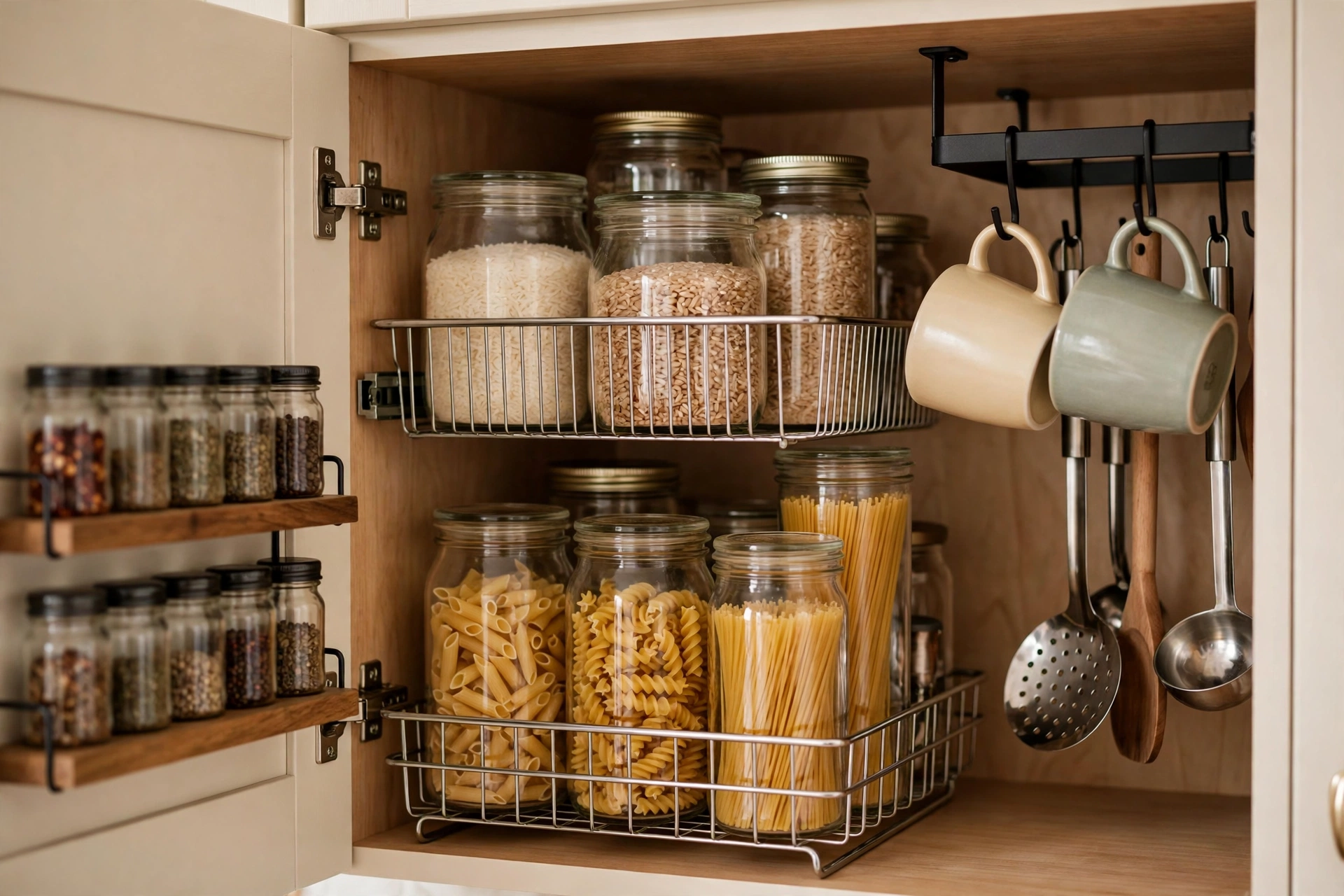
Deep cupboards are where things go to die. You can only reach the front third of a 600 mm deep base unit, so the back becomes a graveyard of tins and packets. Pull-out wire baskets solve this completely: the whole shelf slides towards you, so you can see and reach everything. They are available for most standard UK unit widths from IKEA, Dunelm and specialist suppliers, and many are designed to fit inside existing cupboards with no joinery work.
Door racks are the next best buy. A slim rack screwed or hooked over the inside of a cupboard door holds spices, oils, cleaning sprays or cling film, using space that is otherwise completely empty. A three-tier rack costs less than £15 and can clear an entire shelf. Stackable shelf risers do the same job inside the cupboard itself, letting you store mugs above plates or tins above tins without stacking things precariously.
For dry food, decant into matching glass jars or clear containers. It sounds like a styling tip, but it is really a space tip: uniform square containers waste far less room than a jumble of packets, and you can see at a glance what needs replacing. A row of jars on a pull-out basket turns a chaotic cupboard into a tiny pantry.
Keep the Worktop Clear
A clear worktop makes a small kitchen feel twice as big, and it is the single best predictor of whether a kitchen feels tidy or chaotic. That means finding a home for everything that currently lives on the surface. The kettle and the toaster usually earn their place. Almost everything else, the fruit bowl, the knife block, the chopping boards, the air fryer, can move.
Chopping boards can hang on hooks inside a cupboard door or slot into a narrow vertical divider. Baking trays and cooling racks can stand upright in a tension rod or a file organiser inside a tall unit. Small appliances you use weekly rather than daily can live on a high shelf or in a cupboard, brought out only when needed. If your air fryer is used every day, give it a dedicated corner; if it is used once a fortnight, it does not deserve permanent worktop space.
A small draining board that folds away, or a dish rack that sits over the sink, saves the space a permanent rack would take. The same principle applies to the washing-up bowl: a collapsible one stores flat when the dishes are done.
Corners, Plinths and Dead Space
Corner cupboards are notorious for wasted space, but a rotating carousel or a pair of pull-out trays can reclaim most of it. LeMans-style pull-out shelves, which swing out of the corner and towards you, are the most effective fix, though they cost more than a simple carousel. Even a cheap lazy Susan turntable, the kind sold in B&M and Homesense for under £10, makes a corner cupboard usable for oils, sauces and tins.
Look lower, too. The plinth beneath your base units, that recessed strip at floor level, can hold shallow drawers for baking trays, placemats or pet bowls. Plinth drawers are a popular retrofit in UK kitchens and cost far less than new units. The gap above wall units is another dead zone: a row of baskets up there holds rarely used items such as the Christmas cake tins or the picnic set, out of sight but still accessible with a small step stool.
Even the side of a tall unit or the end panel of a run of cupboards can work. A slim spice rack, a hook rail or a magnetic strip on the end panel gives you storage without taking a single centimetre of floor space. In galley kitchens and narrow layouts, these slivers of space are often the difference between tidy and cluttered.
Storage Ideas for Renters
Renters face the hardest version of this problem, because drilling into walls or fitting pull-outs is usually off the table. The good news is that most of the best small kitchen storage ideas need no permission at all. Tension rods wedged inside a cupboard create a second shelf for lids or trays. Over-door hooks and racks hang on cupboard doors with no screws. Freestanding shelf risers and stackable baskets sit inside existing cupboards. Adhesive hooks, the removable kind, hold utensils, tea towels and measuring cups on walls and tiles and come off cleanly when you move out.
A freestanding trolley is a renter’s best friend. A slim three-tier trolley from IKEA can live beside the fridge or at the end of a worktop, holding fruit, vegetables, oils or cleaning supplies, and it rolls out of the way when you need the floor space. If you are working with a tight budget, our guide to decorating a rented flat on a budget has more low-cost ideas that do not risk your deposit.
Which Storage Solution Suits Your Kitchen?
Not every idea fits every kitchen, so match the fix to your layout and your budget. Here is a quick comparison of the most useful options for a typical small UK kitchen:
- Open shelves: about £15 to £40 per shelf; best for everyday crockery and for kitchens with empty wall space above the worktop.
- Wall rail with hooks: about £5 to £20; best for utensils and pans, and ideal for galley kitchens where cupboard space is tight.
- Pull-out wire baskets: about £25 to £60 per unit; best for deep base cupboards where things get lost at the back.
- Door racks: about £8 to £15; best for spices, oils and cleaning products, and a good first buy for renters.
- Shelf risers and stackable baskets: about £5 to £15; best for doubling the usable space inside wall cupboards.
- Corner carousel: about £30 to £80; best for reclaiming dead corner cupboards in L-shaped kitchens.
- Freestanding trolley: about £25 to £50; best for renters and for kitchens with a spare sliver of floor space.
Start with the cheapest fix that solves your biggest frustration. If you can never find anything in the cupboards, buy pull-out baskets first. If your worktop is always covered, start with a wall rail and a shelf. One good fix beats five half-used organisers.
A Simple Five-Step Plan
If you want to sort your kitchen this weekend, follow this order and you will see the biggest change for the least money:
- Declutter one cupboard at a time and remove everything you have not used in a year.
- Group what is left by use: everyday cooking, baking, cleaning and eating, then give each group a zone.
- Fit one wall rail and one shelf above the main worktop for the things you reach for daily.
- Add pull-out baskets or risers inside the two cupboards you open most often.
- Decant dry food into matching jars so you can see what you have and stop buying duplicates.
The same thinking works beyond the kitchen. If your bedroom is short on space too, our small bedroom storage ideas and IKEA small bedroom storage hacks use the same principles: vertical space first, everything with a home, and nothing on the surfaces that does not earn its place.
Frequently Asked Questions
How can I add storage to a small kitchen without renovating?
Use the walls and the insides of your cupboards. Open shelves, wall rails with hooks, over-door racks and pull-out baskets add a surprising amount of space with no building work, and most of them cost under £30. A freestanding trolley also adds storage without touching the fabric of the room.
What is the best storage for a very small UK kitchen?
Pull-out wire baskets inside deep base cupboards make the biggest difference, because they let you reach the back of the cupboard. Pair them with a wall rail for utensils and one open shelf for everyday crockery, and you will free up at least one full cupboard for food.
How do I organise a small kitchen on a budget?
Start by decluttering, which costs nothing and often frees a whole shelf. Then buy the cheapest fix for your worst problem: shelf risers and door racks cost under £15, and tension rods, hooks and stackable baskets are available in B&M, The Range and Poundland. Buy one solution at a time rather than a whole set at once.
Can renters add kitchen storage without drilling?
Yes. Over-door racks, tension rods inside cupboards, freestanding shelf risers, adhesive hooks and rolling trolleys all need no screws or drilling. Check your tenancy agreement before using strong adhesive fixings on tiles, and keep receipts for anything you fit so you can remove it cleanly when you move out.
