
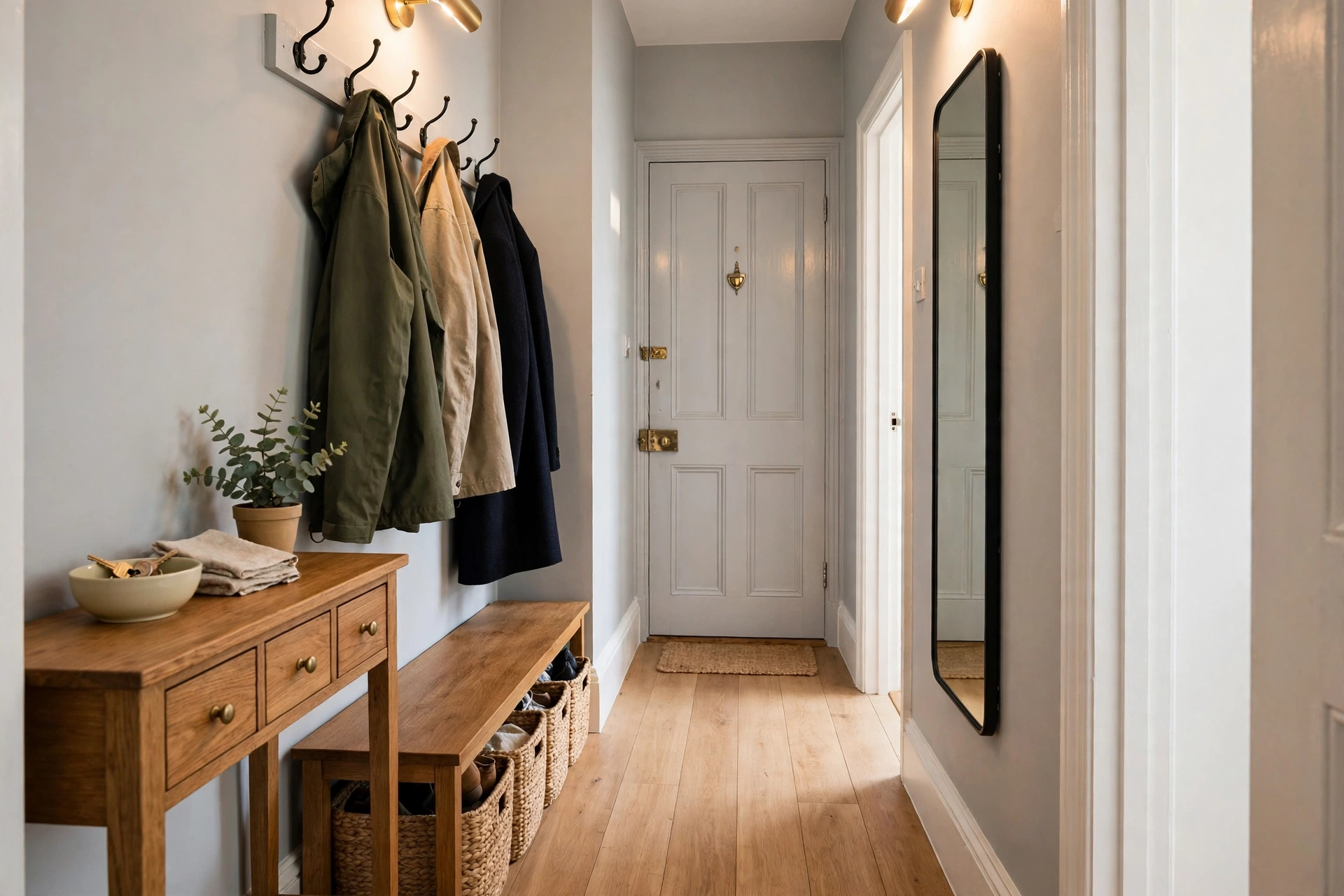
Short answer: The best small hallway storage ideas in the UK work with the space you already have: a slim shoe cabinet no deeper than 200 mm, a row of hooks at two heights, a narrow console or floating shelf, and a basket per person. Keep the floor clear, use the walls and the space above the door, and choose pale colours so a narrow hall still feels bright and welcoming.
A hallway is the first room anyone sees, yet in most British homes it is also the smallest. Flats, Victorian terraces and new-build houses alike tend to squeeze the hall into a corridor barely wide enough for two people to pass. The result is familiar: shoes piled by the door, coats draped over the bannister, post balanced on the radiator and keys lost somewhere in the chaos. The good news is that a small hallway does not need an extension or an expensive fitted unit. It needs storage that is shallow, vertical and easy to use every single day.
What counts as good hallway storage?
Good hallway storage is storage that fits the room without blocking it. In practice that means furniture less than 200 mm deep, hooks and shelves fixed to the wall rather than standing on the floor, and a clear route from the front door to the rest of the house. Anything that forces you to turn sideways, trip over shoes or squeeze past a coat rail has failed, however pretty it looks. The aim is simple: everything you need when you leave the house — shoes, coat, keys, bag, umbrella — should have one obvious home within arm’s reach of the door.
1. Solve the shoe problem first
Shoes cause most hallway mess. A family of four can easily leave eight pairs by the door, and in a narrow hall that is enough to block the whole walkway.
- Slim shoe cabinets: Tilt-out cabinets from IKEA, Dunelm or The Range are usually 170–200 mm deep and hold 8–12 pairs. Fix them to the wall so they cannot tip, and keep only the shoes you wear this week inside.
- Open shoe racks: A two-tier rack under a bench works well if you are honest about numbers. One pair per person on the rack, the rest stored elsewhere.
- A shoe tray: A simple rubber or metal tray by the door catches muddy boots and wet umbrellas, protects wooden floors and makes the daily tidy-up a ten-second job.
- Seasonal rotation: Store out-of-season shoes in a labelled box on top of a wardrobe. Hallway storage is for today, not for every pair you own.
If your hallway is under 900 mm wide, skip freestanding furniture altogether and use a wall-mounted cabinet. Building regulations guidance for accessible homes recommends a clear hallway width of at least 900 mm, which is a useful reminder of how little room there really is: a cabinet 300 mm deep would eat a third of the walkway.
2. Hooks, rails and pegs beat a coat stand
A freestanding coat stand takes up floor space, wobbles and holds about four coats before it looks like a jumble sale. Wall hooks do the same job in no floor space at all.
- Two heights: Fit a rail or row of hooks at 1,700 mm for adults and a second row at 1,100 mm for children, bags and dog leads. Children who can reach their own hook actually use it.
- One hook per person: Give everyone a named hook. When a hook is full, something has to go back in the wardrobe — that one rule keeps coats under control.
- Peg rails: A simple wooden peg rail from B&M or Homesense costs very little, suits period homes and modern flats alike, and holds coats, hats, scarves and tote bags.
- Hooks on the door: Over-door hooks on the inside of a cupboard or bedroom door add storage without a single screw in the wall — ideal for rented flats.
3. Add a narrow console or floating shelf
Every hallway needs somewhere to put keys, post and a phone while you take your shoes off. A console table 200 mm deep does the job, but in a very narrow hall even that is too much.
A floating shelf is the better answer. Fixed at about 900 mm high, a shelf 150 mm deep holds a key bowl, a small dish for loose change and a vase, and leaves the floor completely clear underneath — which makes the hall feel wider and makes cleaning far easier. Paint it the same colour as the wall so it almost disappears, or choose a warm oak shelf for contrast against pale grey walls. Good lighting above the shelf, such as a small wall light or a picture light, turns a plain shelf into a proper feature.
If you do have room for a console, look for one with a drawer. A drawer hides the clutter — gloves, spare keys, the tape measure — that would otherwise live on top of the table.
4. Give everyone a basket
Baskets are the unsung heroes of small hallway storage. A woven seagrass or fabric basket on a shelf, under a bench or on top of a cabinet swallows hats, gloves, scarves and school bits in seconds, and it looks far better than a plastic box.
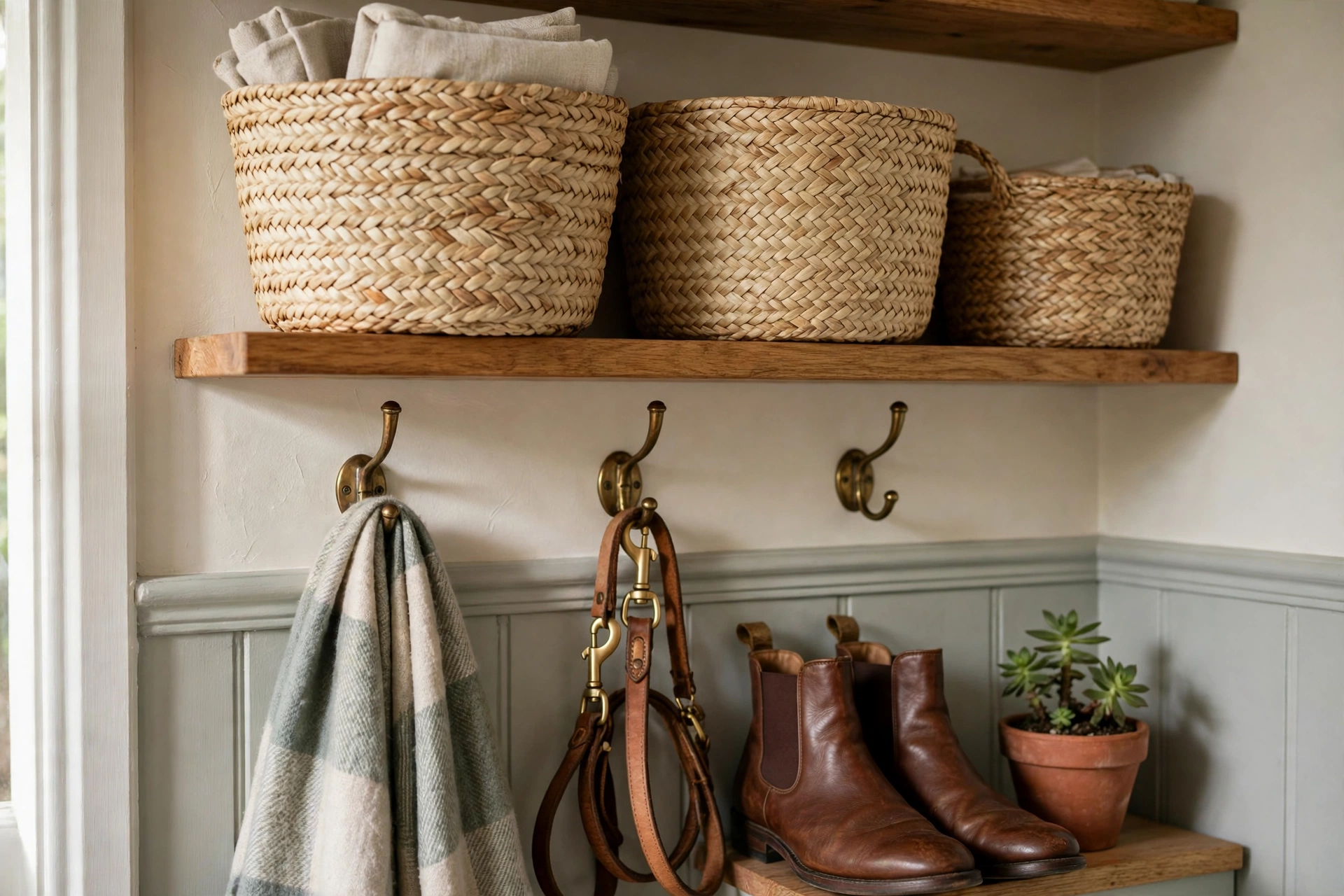
- One basket per person: Each family member gets a basket for their own bits. When it is full, it is time to sort it out.
- Labelled boxes: For shared items — spare bulbs, batteries, the dog lead — use small labelled boxes on a high shelf.
- A bench with storage: If you have around a metre of wall, a low bench with baskets or a lift-up lid underneath gives you somewhere to sit while you put shoes on and hides a surprising amount.
5. Use the space above the door and under the stairs
The two most wasted spots in a small hallway are above the front door and under the stairs. A shelf above the door, fixed high enough to clear it, is perfect for items you need rarely: spare light bulbs, the Christmas decorations box, a spare roll of wrapping paper. In a Victorian terrace hallway, a shelf that matches the picture rail or cornicing looks like it has always been there.
Under-stairs space is even more valuable. Even a shallow cupboard under the stairs can hold a vacuum cleaner, coats, the ironing board and a stack of shoe boxes. If the space is open, fit a curtain on a tension rod or a simple cupboard door to hide it. A pull-out shoe drawer built into the lowest stair tread is a clever joinery trick, but even a row of stackable boxes on the floor of the cupboard is a big improvement on a pile by the door.
6. Mirrors and colour make storage feel lighter
Storage only works if the hallway still feels pleasant to walk through. A large mirror opposite the front door or above the console bounces daylight down the hall and makes a narrow space feel twice as wide. Choose a slim mirror with a thin frame so it does not eat into the room, and hang it where it reflects a window or a light rather than a blank wall.
Colour matters too. Pale colours on the walls — soft white, pale grey or a gentle sage — keep a windowless hall bright, while painting the storage itself in a deeper shade, such as Farrow & Ball Hague Blue or Dulux Sapphire Salute, turns a plain shoe cabinet into a feature. If your hallway is very dark, a warm white bulb (2,700K) in the ceiling light and a mirror together make more difference than any amount of furniture.
7. Storage that suits your home
Different homes need different answers. Here is a quick guide to choosing the right combination for your hallway.
- Rented flat: Over-door hooks, a freestanding slim shoe rack, a tray for shoes and command-strip hooks. Nothing screwed into the walls, everything you can take with you.
- Victorian terrace: A peg rail, a narrow console, a large mirror and under-stairs storage. Keep the period details — cornicing, dado rails — and choose wood and brass finishes that suit the house.
- New-build house: A wall-mounted shoe cabinet, floating shelves and a bench with baskets. New-build halls are often the narrowest, so wall-mounted storage is usually the only option that works.
- Family home: One hook and one basket per person, a bench to sit on, and a strict rule that the hallway holds only today’s shoes and coats.
- Small budget: Start with hooks and baskets from B&M or The Range, add a shoe tray, and paint an old cabinet to match the walls. You can transform a hallway for under £50.
Keep it tidy in five minutes a day
The best storage in the world fails without a routine. The trick is to make the routine tiny. Every evening, take two minutes to put shoes in the cabinet, hang coats on their hooks and drop post into the basket. Once a week, spend five minutes emptying the key bowl, returning anything that does not belong in the hall to its proper room, and wiping the console. That is all it takes. A hallway that is tidied little and often stays tidy; a hallway that is only sorted once a month never does.
It also helps to be honest about what lives in the hall. If a coat has not been worn in a month, it belongs in a wardrobe. If a pair of shoes is only worn at weekends, it belongs in the bedroom. Hallway storage is prime real estate — reserve it for the things you reach for every single day.
Frequently Asked Questions
How deep should hallway storage be?
For most UK hallways, storage should be no deeper than 200 mm. Slim shoe cabinets are typically 170–200 mm deep, and floating shelves of 150 mm work well. Anything deeper starts to block the walkway, especially in halls under 900 mm wide.
What is the best shoe storage for a very narrow hallway?
A wall-mounted tilt-out shoe cabinet is the best option for a very narrow hallway. It holds 8–12 pairs in about 170 mm of depth, keeps shoes hidden, and leaves the floor clear. If you rent, a slim open rack no deeper than 200 mm is the best freestanding alternative.
How do I store coats in a hallway with no cupboard?
Fit a row of wall hooks or a peg rail at two heights — 1,700 mm for adults and 1,100 mm for children — and give each person one hook. Add a basket underneath for hats and gloves, and keep only the coats you wear this week in the hallway; the rest belong in a wardrobe.
How can I make a small hallway look bigger?
Use a large mirror to bounce light, paint the walls a pale colour, keep the floor clear with wall-mounted storage, and choose furniture in the same colour as the walls so it blends in. Warm white lighting and a clear sightline from the front door to the next room also make the space feel larger.


